Wednesday, November 23, 2011

Compost Tea: Put a Bit of Magic in your Garden!

What is it?:  Liquid fertilizer
What is it made from?: Organic waste
Why use it?:  How long have you got?
NOTE:  This is a fun gardening activity to do with children


A bottle of the good stuff - undiluted, homemade, compost tea.
The tradition of using compost tea to feed the garden is centuries old and each community has their special way of making it that is steeped - like tea, in collective, shared and ancient knowledge.  This next bit makes me feel very ancient, but I was brought up in inner-city London in the era of horse drawn carts that brought bread, milk, coal and the rag and bone man (scrap stuff).  We used to keep a coal shovel by the front door so that we could race out and scoop up the horse poop, after these tradesmen have been around, before our neighbour 'Old Fenton' got to it.  He wanted it for his prize dahlias and my father wanted it to make compost tea for his allotment. Simple pastimes before the days of television and computers.


When I came to Sydney in the mid-seventies we moved to an area with lots of Greek and Italian migrants that had abundant edible gardens. I paused in wonder at seeing for the first time things growing that I had only ever seen in books - like aubergines and fennel with oranges and lemons hanging over the garden walls.  Most of these gardens had a large barrel that contained their special liquid 'brew',  with a recipe brought from Kythera or Calabria.  It also helped that around them, in every back lane, were the stables for Randwick racetrack and mountains of free horse manure. 


1 Simple Compost Tea:
  • You will need: A bucket, an old hessian bag or cotton pillowslip for your tea bag and a good few handfuls of compost.
  • Put the compost in the bag, secure the top and dunk it in the bucket filled with rain water.
  • Soak for a week, jiggling the bag a few times a day.
  • Dilute to the colour of tea and pour directly onto the soil.
NOTE:  This is a very good brew for activating a 'tired bed' or a new no-dig bed.  It is loaded with micro-organisms that gets organic matter breaking down and subsequently soils revitalized pretty quickly.


2 My Compost Tea:  3 things - SEAWEED (brown kelp), ANIMAL MANURE and fresh COMFREY LEAVES.  Why these three?


  • Seaweed enriches the soil: Seaweed is a broad spectrum fertilizer that is rich in beneficial trace minerals and hormones that stimulate plant growth. Seaweed is high in carbohydrates which are essential building blocks in growing plants, and low in cellulose so it breaks down readily. Seaweed shares no diseases with land plants. Boosts lethargic plants: Seaweed fertilizer contains an abundance of fully chelated (ready to use) micro-nutrients which can be readily absorbed by plants without any further chemical decomposition needed. Seaweed is high in potassium - essential for the production of healthy roots, flowers and fruit.
  • Animal manures contain a multitude of beneficial organisms and nutrients that biologically activate your brew and subsequently your soil. They are usually high in the three essential plant macro-nutrients nitrogen, phosphorus and potassium. By composting them this way you eliminate any 'nasties' in them like weed seeds, animal pathogens, chemicals and drugs that may have administered to the animals to make the ideal liquid fertilizer.
  • Comfrey is a dynamic accumulator - that is it 'mines' nutrients from the soil so adding it to your compost tea will boost it's macro and micro nutrient levels - essential for plant growth. It is very high in nitrogen and contains 2-3 times more potassium than farmyard manure. Comfrey is fast-growing, herbaceous, perennial plant of the borage family with a thick and tuberous root system, allowing the plant to 'mine' compacted soils for minerals and other nutrients which are often difficult for other plants to obtain. It is an essential addition to any garden.
  • What you will need:
  • A container with a lid for mixing your brew in - I use a garbage bin.
  • Some seaweed.  (You are not supposed to collect any from the beach, but I figure that by making my own compost tea, and not buying manufactured fertilizer in a plastic container, that collecting a handful of seaweed is doing very little harm - discuss?)
  • An old pillowcase with a rubber band for sealing it - this is your tea-bag - just make sure it is made from a natural fibre - like cotton!
  • Some comfrey leaves.
  • Small bucket of manure.
  • Rainwater for mixing it - chlorine in town water harms biological activity.
  • Somebody who knows how to make spells.
  • How to make it:
  • Put the comfrey, seaweed and manure in the pillowcase and seal it with the rubber band.
  • Soak it in the bin that is three-quarters full of rainwater.
  • Chant your spell while giving it a good stir. (Suggestion below)
  • Leave it to soak for a couple of weeks  giving it a stir now and again.  NOTE:  You can keep on using it over a few months until it is used up.  The comfrey will make it smell!
  • How to use it: 
  • As a liquid fertilizer for the soil:  Scoop out some of the brew into a bucket or watering can, dilute to the colour of weak tea and water into the soil for a fast and fantastic nutrient boost.
  • Directly applying the diluted compost tea brew to the leaves as a  foliar spray has a multitude of benefits – it is a gentle tonic for the plants that is absorbed straight away – a liquid fertilizer boost (it takes more time via root system) also the micro-organisms help to protect the plants against disease. This is particularly beneficial against fungal attack e.g. mildew on zucchini/peas and beans. NOTE: You will have to strain the brew if you are using it in a sprayer.
  • I use it to give plants a potassium boost when they are in bud (eg. beans and strawberries - in fact anything that is going to flower and fruit) to encourage the production of flowers and fruit set.
  • Seedlings and young plants will also benefit from a compost tea spray every 3-4 days for a phosphorous boost, which they need for the development of healthy roots.
  • Stress relief!!  You need it and so do plants, particularly when you are transplanting seedlings.  By giving them a spray with dilute compost tea you are giving them a boost of vitamin B1, which is a constituent of seaweed, and reducing transplant shock.


Fillet of a fenny snake,
In the caldron boil and bake; 
Eye of newt, and toe of frog, 
Wool of bat, and tongue of dog, 
Adder's fork, and blind-worm's sting, 
Lizard's leg, and owlet's wing,— 
For a charm of powerful trouble, 
Like a hell-broth boil and bubble. 
Double, double toil and trouble; 
Fire burn, and caldron bubble. 
Macbeth, William Shakespeare


For information on COMPOSTING(cold)  and HOT COMPOSTING got to previous posts - simply use the SEARCH box.  Di

Saturday, November 12, 2011

Spring in Sydney

Vaucluse House

I have been down in Sydney for a few weeks being with my youngest daughter while she waited for the birth of her first child. It wasn't an arduous task for me (she probably has a different viewpoint!) - because November has always been my favourite month in Sydney.  Winter  has finally blown away, the ocean sparkles, the scent of star jasmine (Trachelospermum jasminoides) fills the air and the harbour foreshores are given a 'blue rinse' with the magnificence of flowering jacaranda trees. Every now and again you catch an accidental/inspired collection of flowering plants that just puts a smile on your face.  Try a jacaranda next to the scarlet of an Illawarra flame tree, next to the golden yellow of a silky oak, next to the creamy white of a melaleuca with crimson bougainvillea spilling over a sandstone wall? Nature, weaving magic.

Ladies Baths, Coogee
Debate raged in the daily paper while I was there when one correspondent suggested that all 'exotic' plants should be removed from Australian gardens and replaced with 'natives' picking on , in particular, the jacaranda tree a-native of Brazil. Well, he almost started World War III.  His argument just doesn't make sense.  Gardens everywhere have always been an eclectic mix of plants from all around the world whether they be trees, shrubs or vegetables.  My garden, for one, would be empty- no frangipani, gardenias, citrus, papaya, bougainvillea, tomatoes, gingers-the list is endless. Of course in difficult climates and conditions it makes sense to grow whatever plants are best adapted to those conditions - usually 'natives'.  

I would agree with him though with regard to street tree plantings.  Very often the choice of  trees gives no sense of place at all - look around you in most cities and you could be anywhere in the world.  This puzzled me until I was employed by Waverley Council in Sydney in the 1980's and realised that almost up until then they had no horticulturists/arborists working at Councils and street trees choices were made by the Chief Engineer who worked from a list of about 6 trees.  Then I went to Barcelona, visiting a landscape architect friend of mine, and looking around you could have been in Sydney with their gum trees, Canary Island date palms and London plane trees.  He said they had a list of about 7 trees and only two were different from the Sydney list!  It's a personal thing but for me the beautiful lavender blue of the tropical jacaranda enhances the Sydney streets capes in a way that the London plane tree just doesn't, contrasting so well against the warm sandstone buildings of Sydney (e.g. along Oxford Street, Paddington outside the Barracks).


Parsley Bay, Vaucluse


So we are bequeathed often inappropriate, boring, street trees that have usually been amputated by poorly trained tree loppers because they have to try and grow amongst an ever-expanding tangle of overhead power-lines. What a different place Sydney would look if the then Premier, Bob Carr, had got his way in 2000 and, as a lasting new millennium project, had put all power lines in Sydney under the ground.  How wonderful it would be to drive around Sydney with avenues of trees arching above you. Go around the harbour-front at Rose Bay and see the magnificent arbour of'local' fig trees (power lines under the ground!) and you will get a glimpse of what we could have.

Another bonus to being in Sydney at this time of year is that my favourite swimming spots are still relatively empty - the water still too cold for most folk. I love swimming. Swimming has saved me many times - it seems to have the natural power to cure and always lift my spirits.  When I swim in the sea I feel totally free - gravity suspended - and I have never had a swim that didn't make me feel better. Plus, it is exceedingly good exercise for gardeners!  So I just thought I would share some of my favourite swimming spots with you.


Then finally, after a long wait, our dear little grandson was born on 3 November.  After 5 grand-daughters he was a bit of a surprise, but a beautiful one.


Taj Felix 
My Favourite Things to do in Sydney No.1: Bondi to Bronte walk, Sculptures by the Sea (pack a pair of bathers and a small towel).

Start with a coffee at Speedos Cafe, North Bondi and say hello to the lovely Anna and her sisters who have being running this place for years. Get a seat by the window and take in the view. When my brother arrived for a visit from the UK after one trip to Speedos he said "just leave me here for two weeks and I will be a happy man". I have been going in this cafe since it started (about 25 years ago).  The building reflects a time when Bondi was a bit shabby (the original owner was 'colourful Sydney underworld figure' Abe Saffron) but Bondi has always been colourful itself with steady waves of alternating migrants. When I first came here in the 70's you heard the accents of middle Europe from Warsaw and Budapest - Holocaust survivors and their children.  I remember being chilled to the core seeing, for the first time, a  woman in a supermarket with a camp tattoo on her arm.  Wander around now and the accents of Durban and Minsk have mostly replaced them. 
Pumped with caffeine take time to have a look at the mosaic mural around the baby pool at North Bondi before you walk along the promenade south to Bronte.  The endearing joy of Bondi Beach, in any weather, is that you totally forget that the city is bustling on behind you and that you are less than 7km from the city centre.

'Admire' the graffiti on your way.  In particular the tribute to the Anzacs and those who died in the Bali bombing where flowers have been left every day since 2005.


'Buddha takes a a holiday'
Traverse around the Bondi Icebergs swimming pool and go back later for a cocktail in the iconic Icebergs Restaurant.  Dodge the joggers and step out onto the most easterly point at Mackenzies Bay to wonder at the Aboriginal carving of a stingray on the flat rocky outcrop.  By now you will be able to see some modern art from the always inspirational  Sculptures by the Sea, now in it's 15th successful year.  Don't forget to look out to sea because between June and November you often see migrating whales. A couple of years ago, walking along this track, I noticed a pair of leaping, spouting whales and pointed it out to a couple of young tourists walking by.  They looked, blinked, then looked again and said "Are they real"  - I smiled happily and replied "Yes, that's where they live"


Keep going past Tamarama Beach ('Tamaglama') home to the buffed and waxed beautiful young things.

Tamarama Beach - not Easter Island 
Leave plenty of time to look at the sculptures. The juxtaposition of blue sky, aqua Pacific and white sand just adds another dimension to my experience and enjoyment of others creativity.  


The surf at Tamarama is notoriously treacherous - so make sure you swim between the flags or in one of the ocean pools around the corner at Bronte Beach.  This beachside suburb maintains it's 1920's feel with landscaped park, model train for the kiddies, Norfolk Island pine trees and picnic sheds.  Day in and day out the benches around the ocean pool are lined with the same guys - they have designated this area 'Dr. Bronte' and I can see why.


They swim, yarn, go for a coffee, check out the racing'form' for the day, spend hours looking out to sea and doing the crossword in the daily paper   Beats staying home and watching the tellie.
If you have time - go for a walk in Bronte Park up the gully to the waterfall at the top and rest for a while of the big flat rock. A quiet place in a busy city that has special significance for local Aboriginal women going back thousands of years.
At weekends this park is crowded with with large groups of picnicers that looks and sounds like the League of Nations.


Now it's time for your swim.  Take your pick from the ocean pool, bogey hole and sea (if you are a strong swimmer - I learned all about rips at this beach).  Then have lazy lunch at one of lovely cafes (just don't go on a Sunday!)


If you have time keep walking round to the next beach of Clovelly.  In fact, you can pretty well walk along the coastline from Bondi Beach to Maroubra Beach - about 9km and you would not get any better views along the east coast of Australia or a better feel for seaside Sydney. Hooroo!

Sunday, October 30, 2011

Pest Control: Fruit Fly Baits

If you hear a gardener cursing they have probably noticed some fruit fly damage on their tomatoes/nectarines/citrus etc.  It's one of the most disheartening things about gardening in a fruit fly prone area -  to nurture a crop to maturity only to see, just as it's ripening, the destructive damage of the fruit fly, which ruins all the fruit.  This was just about to happen to my tomato crop when Rasa came to the rescue.  


I was up at her wonderfully productive garden for a Seed Savers event when I noticed bottles like these hanging from all the fruit trees.  I realised they were fruit fly baits and now I have her very effective recipe which is working in my garden too. I think it's quite ingenious and a better design than any others I have seen.  Do it early in the season to help interrupt the life cycle of this pest.


What you will need:
Old plastic containers with lids and handles
Some yellow tape (electrical sticks well)
2 litres warm rainwater, 2tbs honey, 2tbs cloudy ammonia or urine and 2tsp vanilla essence.
Mix it up until the honey has dissolved.  Cut three triangle shapes in the bottle and surround them with the yellow tape (this attracts the critters).  This amount is enough for about five bait bottles.  You will need to replace the brew regularly because it gets full up with fruit fly!  This depends on your situation - it could be weekly or monthly.

Update 1 October 2014.  While the above recipe is effective it tends to be rather smelly - you can try the following for a less offensive brew; any kind of fruit juice, a sprinkle of sugar and brewers yeast - mix it up and use the same container as above.

About Fruit Fly
There are several pests described as 'fruit fly' in Australia. The main one in the eastern states is Queensland fruit fly (Q fly) Bactrocera tryoni, which is native to rainforest habitat on the east coast of Australia. It is generally more active as the weather warms up in the summer.


The female flies lay their eggs in small groups just beneath the skin of fruit. The larvae are referred to as 'maggots' and are creamy white, tapering towards the head and between 7-9 mm long when fully grown.  Q fly develop from eggs to adults within 5 weeks in hot weather.  The maggots hatch and by their feeding as well as bacteria they carry, cause the fruit to rot and drop. When the maggots are fully grown they leave the fruit and burrow into the soil, where they pupate.  That is why it is very important to clear up rotting fruit from under the trees and remove it from your plants and destroy it when you notice the damage.  What does the damage look like?  On tomatoes you will see a black little pinhole - if you cut it open you will see the 'maggot' damage.


Adults can live for many weeks and flies commonly over-winter as adults, becoming active when the weather warms up around August and gradually the population builds to a peak in late summer.  Trees that fruit early in the season (like loquats) and fruit late (like figs) can help this pest to 'overwinter' and perpetuate the cycle so think about removing them.


The tiny flies that hover around the fruit bowl are fungal gnats and are attracted by decomposition; they are commonly mistaken for fruit flies.


NOTE:  I am wary that these baits may also catch desirable insects like bees, hoverflies and lacewings so that needs to be monitored.  I will give you an update.

Saturday, October 29, 2011

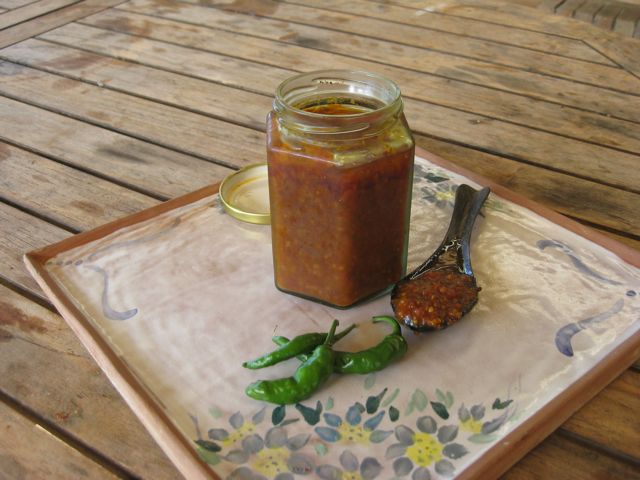
Recipe: Kasundi (Indian Tomato Chutney)

I had a glut of tomatoes and green chillies and saw a version of this  recipe in the paper - it's something I have never come across before.  The taste is fabulous - rich, pungent and spicy and great with eggs, curries and rice dishes.  Easy to make and will keep, unopened in the fridge, for six months or more.  I used a food processor to grate the garlic, chilli and ginger and then the blade to chop up the tomatoes so the preparation was easy.  The recipe is adaptable to your own taste.


4tbs peanut oil - or other vegetable oil (not olive)
2tbs black mustard seed
2tsp turmeric powder
1tbs ground cumin
2tsp chilli powder
1tbs minced garlic (fresh)
2tbs minced ginger (fresh)
6 fresh green chillies, seeds removed
2kg ripe tomatoes, chopped
1tbs salt, approx.
300ml malt vinegar
250g brown sugar (I used a mixture of brown and coconut sugar)


Heat oil in a heavy based pan and add mustard, turmeric, cumin and chilli powder.
Stir and cook for 3-4 minutes, being careful not to burn spices.
Add minced garlic, ginger and chilli and cook for a further five minutes.
Add tomatoes, salt, vinegar and sugar, reduce heat to low and simmer for 60-90 minutes, stirring occasionally until sauce thickens and oil comes to the top.
Remove from heat and store in sterilised jars.

Tuesday, October 18, 2011

Pest Control & Companion Planting: Cabbage White Butterfly

The problem with being on holiday in springtime is that I am thinking about the garden the whole time - if you didn't know it by now I am telling you, gardeners are obsessive!  I don't know if you have noticed but gardeners never sit in their gardens - they are always doing something.  No sooner so I sit down with a cup of tea and a the paper and I am up; pulling out that weed, marvelling at something that has just begun to flower, harvesting beans that need picking and pulling off caterpillars.  In fact, that was the first thing I did when I returned from my holiday - walked out into the garden and did a health inspection.  Because, after all - early intervention often saves a whole crop of food.  The rest of it can wait; dead-heading flowers, pruning shrubs, weeding, mulching, mowing - unimportant compared with my food plants.  Mostly everything looked pretty healthy apart from these!
Caterpillar of the cabbage white butterfly
WHAT: I only had to look at my kale plants to see that they were being devastated by the caterpillar of the cabbage white butterfly.  Tell-tale holes, munching of the new growth and it didn't take long before I spotted those well-fed green culprits camouflaged along the mid-rib of the leaves.  

I  turned over a few leaves and saw the little patchwork clumps of eggs waiting to hatch out into the damaging caterpillar stage.


Look for clumps of eggs on the underside of the leaves.  These were on my kale plants and are already hatching out into the damaging caterpillar stage

WHO: The adult cabbage white butterfly(c.w.b.) is a small creamy/white butterfly with two black spots on it's wings and it is only interested in plants in the brassica(cabbage) family.  This is where an understanding of vegetable families, and companion planting is going to make you a better gardener.  

HOW:  The cabbage white butterfly is not attracted to any plant that is not in the brassica family.  So what do smart gardeners do?  They interplant with those from another family because the c.w.b. will leave those alone. They may be so confused that they don't even settle on your brassica plants and fly off to someone else's garden where they have conveniently planted their cabbages in neat rows!!  (Does nature ever do that?)


Understanding how your garden works is a lot about observation.  Follow a c.w.b. around the garden and see that it has to land three times on a brassica plant before it settles and starts to lay it's eggs.  If it is confused by other plants of a different smell, size, shape, flower - it will head off somewhere else - this is what companion planting is all about.

What do you notice about the beetroot leaves in the above photo - not one munch hole - that is because beetroot is in a different family (chenopidaceae) - it is not a brassica so the c.w.b. will leave it alone.  In fact most of the plants in this family are pretty pest free - this is a good reason to interplant them among your brassicas - it helps confuse the c.w.b., assists with passive crop rotation and means that you always have something to eat.  Let's start with these two families and watch the whole companion planting story unfold from here!

BRASSICACEAE:  cabbage, broccoli, kale, radish, cauliflower, Brussels sprouts, rocket, swede, turnip, bok choy, chum soy, mustard greens.  (You will notice that the stronger smelling and hairiest of these almost never get attacked by the c.w.b. i.e. mustard greens, radish and rocket)
CHENOPIDACEAE:  beetroot, spinach, silver beet, chard, sorrel, amaranth, quinoa.

Being cabbages.  Students at a workshop in Bali role playing the cabbage white butterfly and companion planting story. Who said gardening was boring?
  • Control of the cabbage white butterfly:  Try fooling the butterfly by placing pieces of eggshell  around the garden (the theory is that they will think that there is already a butterfly there and fly off). 
  • Interplant with lots of strong smelling herbs like basil, fennel, parsley, dill and tall flowers like cosmos, zinnia and marigolds - this creates confusion to the c.w.b.  When they flower they have the added benefit of encouraging beneficial insects that wants to do a lot of the work for you.  Do this first - don't reach for the spray can because you will be killing off the goodies too!
  • Make your garden a safe haven for their natural predators - birds and lizards - and don't keep domestic pets that will scare them off.  I have an opportunist magpie that follows me around the garden waiting for me to pick off any caterpillars I find.  Provide areas of ground-hugging shrubbery and lots of shallow bird baths to encourage them.
  • Last resort-spray with Dipel. This is a bascillus that only affects the gut of caterpillars and is safe to use for organic gardeners.
MOST GARDEN PEST CONTROL IS UNNECESSARY - some cause more problems than they solve - be patient - let's grow things, not kill them.
Holiday reading - gardening magazines!


Wednesday, October 5, 2011

Mullum Local Food Festival 2011

Saturday 29 October 10-4 


This should be a great day!!


Come and have a look at the wonderful gardens and abundance at the Mullumbimby Community Garden - so much has happened in such a short space of time.  


I love taking a wander in there in the late afternoon - it's usually a hive of activity with folk working on their garden plots, children playing, insects humming and magpies calling.  What a wonderful asset to our community!


On the 29th there will be activities, stalls, a parade, music and of course lots of delicious food.


And the added bonus of a talk by the always inspiring Jerry Coleby-Williams from ABC Gardening Australia.


I hope to be there with a stall but grandchild No6 is due on the same day, so we will have to wait and see.

Tuesday, October 4, 2011

Recipe: Beetroot - brownies, salads, Greek style, risotto and dips.

Fresh beetroot at the Mullumbimby Farmers Market
Beetroot is one of those really versatile foods that keeps popping up on my food journey and has grown in my estimation.  The trouble is most of us are stuck with the taste and image of that 'stuff' from our childhood - the pickled variety that went with Sunday salad: iceberg lettuce, tomatoes, cucumber and salad cream.  I loved a segment of Jamie Oliver 'At Home' where he did a spoof on this salad and then, at the end, threw the iceberg lettuce in the air and then blasted it with a double-barrel shotgun.  My Aunty Phil, the gods bless her, even had a speciality of pickled beetroot with raspberry jelly!!!!.  Forget about all of that,  I am about to convert the unconverted - here goes.


It's good for you!!!  "Researchers at WakerForest University in North Carolina have shown that a diet that includes about 500ml of beetroot juice per day helps improve blood flow to certain regions of the brain in older people.  In particular the effects were noted in the frontal lobe - a part of the brain that commonly experiences reduced blood flow in age-related dementia and cognitive decline.  The effect is likely to occur because beetroot juice (like spinach, celery, cabbage and other leafy green vegetables) is a good source of nitrates.  These compounds are converted into nitrites by the good bacteria in the mouth, and act as vasodilators - in other words they have the capacity to open the blood vessels and enhance blood flow"  Gardening Australia 2011


Sauteed beetroot tops.  It tastes good!!!  I remember sitting in Nikos Taverna in Kos, Greece and seeing these chaps next to me eating something very unfamiliar - a vegetable I had never seen before.  Well thought I hadn't seen - it was just a part we always threw away - beetroot tops.  I have cooked this many times since and it is delicious.


1 bunch a fresh beetroot leaves
1 clove garlic crushed (optional)
2 tbs olive oil
juice of 1 lemon
cracked black pepper and sea salt


Wash beetroot leaves thoroughly
Blanch in hot water for 1 minute, drain
Meanwhile heat frypan with oil
Toss in garlic and beetroot leaves, add salt, pepper, lemon juice and serve immediately


How about this beetroot dip - you should see the luscious colour!!!
1 par-boiled beetroot about 250g
2 cups Greek yoghurt
1 clove garlic crushed
sea salt and cracked pepper


Peel cooked beetroot and grate.  Add all the other ingredients and eat with strong bread.


Beetroot Brownies.  I am serious!!!
River Cottage Beetroot Brownies
These are very good.  I saw Hugh Fernlay-Whittingstall on his 'River Cottage' TV programme rise to the challenge of making a whole meal (3 courses) from beetroot.  This was one of them.
250g butter
250g chocolate (70% cocoa solids)
3 eggs
250g caster sugar
150g S.R. wholemeal flour
sea salt
250g grated cooked beetroot


Heat oven to 180oC
Melt chocolate ant butter together in large pan on low heat.  Cool
Beat together eggs and sugar.
Add egg mixture to chocolate and butter
Stir in flour and salt
Gently stir in grated beetroot
Spread in shallow square pan lined with non-stick baking paper and bake for 20-25 mins.
Do not over cook otherwise they become too crumbly.


I made these for my Garden Club today and was lucky to get a photo before they disappeared.


Beetroot Risotto - the purple trip continues..........................
I was having a coffee and homemade pastry at Mullum's La Table Cafe this morning when I noticed they had Beetroot Risotto as the lunch special of the day.  Emboldened with organic caffeine I asked chef Dave Ness for the recipe.  I cannot guarantee that this is exactly his (Dave, edit please) - but here goes!


50g butter + 2tbs e.v.olive oil
250ml fresh beetroot juice
600ml stock
250g arborio rice
200g best kind of mushrooms you can get, sliced
150ml red wine
1 clove crushed garlic
1/2 cup chopped chives
75g toasted walnuts
125g goats cheese, crumbled


1.  Heat oil and butter, add garlic (I have an aversion to putting onion in risotto, but others may)
2.  Add rice and sir for a couple of minutes
3.  Add heated stock gradually, stirring all the time + wine at room temp.
4.  Add beetroot juice.
5.  Keep stirring until almost cooked then add mushrooms.  Meanwhile, toast the walnuts.
6.  Correct seasoning and add mushrooms + chopped chives.  Stir through toasted walnuts.
7.  Serve with crumbled goats cheese and garnish with a few chopped chives.
No wonder the Italians have a good lie down after lunch!!


Roast Beetroot Salad:  With goats cheese and pecans.  
This salad is a family favourite that is a meal in itself.


1 bunch fresh beetroot (boil the beets until they are just tender)
2tbs olive oil
250g fresh green beans (you can substitute this with salad leaves/snow peas)
2tbs balsamic vinegar
1/2 cup pecans, toasted
150g goats cheese or fetta
sea salt and freshly ground black pepper


Heat oven to 180oC
When the beets are cooked, peel them and cut into bite size pieces
Toss them in a bowl with 1tbs olive oil and 1 tbs balsamic vinegar and a good dash of salt and pepper.
Spread out on a tray lined with baking paper and place in oven for 15mins.
A couple of minutes before the beets are cooked place the pecans on the tray too and put back in the oven to toast.
While the beetroot is roasting blanch the beans for 1 minute in boiling water and refresh in cold water.  Place in salad bowl
When the beets are nicely roasted - let them cool for a few minutes and then place on top of the beans.  Make a simple dressing with the rest of the olive oil and balsamic and some extra salt and pepper.  Add at this stage to the salad otherwise it will stain the white cheese.
Add the toasted pecans to the salad and crumble over the goats cheese or fetta.


Growing Beetroot:  Beetroot prefer to be grown in moist, fertile soil in a sunny spot, but will also thrive in raised beds or pots.  For foolproof beetroot, sow seeds directly into the soil every few weeks for an almost continuous crop.  Pick the leaves for salad mix and harvest beet from golfball to apple size - full maturity takes about 90 days.