Thursday, August 20, 2015

Walking the Corfu Trail

If you have been wondering why I have been quiet lately the following is your answer.


Nissaki, north-east coast of Corfu

If, like me, you were captivated by Gerald Durrell's My Family and Other Animals when you were a kid you may also, like me, have been harbouring a a burning desire to go to Corfu - the setting for this wonderful book - well this May my long-held wish came true and found me (and him) about to embark on a memorable adventure - a walk around Corfu.

Here's what Durrell had to say about Corfu almost 60 years ago.  The island lies off the Albanian and Greek coastlines like a long, rust eroded scimitar.  The hilt of the scimitar is the mountain region of the island (in the north), for the most part barren and stony, with towering rock cliffs haunted by blue rock-thrushes and peregrine falcons.  In the valleys in this mountain region, however, where water gushes plentifully from the red-and-gold rocks, you get forests of almond and walnut trees, casting shade as cool as a well, thick battalions of spear-like cypress and silver trunked fig trees with leaves as large as a salver.  The blade of the scimitar is made up of rolling greeny-silver eiderdowns of giant olive trees, some reputedly over five hundred years old and each one unique in its hunched, arthritic shape, its trunk pitted with a hundred holes like pumice stone.  Towards the tip of the blade you have Lefkimi, with its twinkling, eye-aching sand dunes and great salt marshes, decorated with acres of bamboo that creek and rustle and whisper to each other surreptitiously.  The island is called Corfu.  Birds, Beasts and Animals  Gerald Durrell 1969

While certain tracts of the coastline of Corfu have been swallowed up in tourist development, much of the interior is still instantly recognisable from Durrell's description written during the five years that his family lived there in the 1930's.  Historic pathways of the interior, connecting one village to another, are still 'off the beaten track' that lead you into a landscape that is both wild and ancient  The patchwork groves of gnarled and towering olives, citrus and almonds are still there.  So too the picturesque coastline, topped by a white domed monasteries that lead to shingle coves of stained glass coloured sea - then, on the scimitars blade in the south, to  wild sand dunes, lagoons, wind blown arching grasses and wading birds.  There might be more hotels, cruise liners and golf courses, but you can get away from it all on the Corfu Trail - you just have to start walking!

The smell of the hilltops still lingers with me, wherever we walked was wonderful - heat, dust, wild sage, thyme with the occasional waft of something sweet and fragrant - jasmine or orange flowers.


We felt very fortunate about the hotel we had booked in Corfu Town - sometimes you just get lucky with the internet!  Housed in a Venetian villa with only nine rooms, our upper floor room looked out, through green-shuttered windows and balcony, to a courtyard dominated by a flowering 200 year old Magnolia grandiflora - then beyond, over the rooftops of the Old Town to the sea and mountains of Albania in the distance.  Breakfast and afternoon tea in this courtyard were an absolute treat with homemade cake always on offer.  We woke in the mornings to the sounds of church bells, doves cooing, children playing and the smell of coffee brewing - a blissful way to start any morning and our holiday.

National folk dance festival - celebrating the day Corfu was unified with Greece after they chucked the British out.  Held in the grounds of the Palace of St Michael and St George, built by the British and their seat of government when they were in power from 1815 to 1864.

And, if this isn't enough to make you want to hop onto a plane and fly to Greece, Corfu Town (the capital) is one of the most beautiful I have ever visited.  A UNESCO World Heritage site dominated by elegant Venetian villas in faded pastel colours, a palace, two ancient fortresses, a sweeping bay, churches, a large park and esplanade (where they play cricket!) and bordering the esplanade the Liston - an elegant arcaded terrace of fashionable cafes and restaurants that rivals anything in Paris.  The whole place has a kind of crumbling grandeur about it.


The Venetian Orthodox church of St Spiridon, Corfu

Corfu owes much of its elegant architectural beauty to its history of occupation; being variously overrun in the past by the Venetians, French, British and Germans but, they will proudly tell you - never the Turks.  This, they believe, is largely due to the divine intervention of the patron Saint of Corfu, St. Spiridon whose relic i.e. mummified body - is held in the Venetian church that bears his name and dominates the old town.  In 1716 a Turkish force of 33,000 men sailed to Corfu and laid siege to the city.  The naval attack was repelled by the Venetians with Count Schulenburg in command, but the attacking Turkish  land army laid siege to the city for 22 days; being eventually defeated when word spread among the Turks that  St. Spiridon had been seen wandering through the streets with a lighted torch and, taking fright, they retreated and surrendered.

NOTE:  For classical music buffs:  After the victorious outcome of the battle Venice honoured Schulenburg and the Corfiots for successfully defending the island by commissioning the great composer Antonio Vivaldi to write an oratorio - Juditha triumphant - one of only four that he composed in his lifetime.
Venetian plaque on the wall of the Town Hall looking a lot like a triumphant Judith to me?

The Corfiots, like a lot of Greeks, are deeply religious and superstitious people and their patron saint is held in great reverence - hence over 60% of males in Corfu are called Spiro and you will hear St Spiridon being called upon to intercede in all kinds of emergencies - traffic altercations, inclement weather, battery running out on phone etc.  I love icon spotting and seeing if I can guess which saint it is by the gear he is wearing - it's all symbolic e.g. George always has a dragon hanging about and John an eagle (he of clear eye).  St Spiro is now instantly recognisable by his flowing white hair and, black crosses on his shoulders and, what looks like, a basket on his head - this goes back to his early days as a shepherd in Cyprus - apparently typical headgear from those parts.  Whe he died in 348AD he was initially buried on Cyprus, but moved to the safety of Constantinople when it was overrun by invading Turks.  When, in 1453, Constantinople fell to the Turks, Spiridon's relics were removed again to safety to Corfu - his final resting place but, as me travelling mate said "he looks like he's been about a bit."

The devout outside St Spiridon's Church

NOTE: He cropped up later on in our trip on Sifnos island in the Cyclades  - which has a tradition and history of ceramic making - old Spiro is also the patron saint of potters because he once used a shard of pottery as an analogy for the holy trinity being one thing but made from three - clay, fire and water. (This was at the First Ecumenical Council of Nicaea in 325AD).  As he was explaining this the shard apparently turned to dust in his hand, which no doubt increased his 'wow' factor, and his fame spread.

A favourite pastime of Corfiots and pilgrims, is to line up and kiss the blackened extremities of his mummified body which is kept in a kind of ice-cream cabinet in the depths of the church watched over by crow-like women who solemnly slide back the lid for you to bend in, pucker up and kiss the old saints blackened and shrivelled toes  - I'm afraid I declined, but had the most overwhelming urge to ask for a Golden Gaytime.  Margo, Durrell's older sister, apparently caught the most frightful influenza from having a 'pash' with Spyro's toes and was banned thence forward by her mother from indulging in "all that superstitious mumbo-jumbo."

St Spiridon with the tell-tale basket on his head, crosses on his shoulders and white flowing beard

What finally got us there this year was not dear old Spiro but the discovery that a walking trail, from top to bottom - all 200km of it, had latterly been marked, mapped and documented - The Corfu Trail.  This is a designated walkers trail with no vehicular traffic, but you might just find yourself sharing it with a farmer, his tractor and the odd flock of  tinkling-bell'd goats, but that's about as busy as it gets.
On top of the highest peak - Pantokrator

WHAT YOU WILL NEED

1.  The trail notes accessed by downloading them from the website The Companion Guide to the Corfu Trail.  They are PDF format and a few euros each - which you can get before you go.

2.  The wonderfully detailed Corfu map by Freytag and Berndt 1:50,000 available in bookshops in Corfu Town (I love a good map!).  When all trail markers had disappeared this saved our bacon many times when we were wonderfully lost, yet again.

HOW WE DID IT

We decided to stay in a small hotel on the north east coast (close to where the Durrells lived) Nissaki, hire a small car and access the Trail for day walks.  This turned out to be  ideal for us as we could swim every morning, before breakfast, in an azure blue cove just below the hotel; easily get to wherever we wanted to by car and come back to the same place every night without having to keep packing up and finding new accommodation.  I had pre-booked this hotel before we left Australia and were fortunately able to extend our stay as we were outside the high season of mid-July to August and it was inexpensive - 35 euros per day.
Nissaki - our morning swimming cove and evening dining spot

DOING THE WHOLE TRAIL IN ONE GO

1.  We gave a lift to a German woman (Karen from Berlin) who had stayed at our hotel for the night, and was about to set off on the last day of a ten day trip, starting in the south and finishing in the north, and covering the whole 220km in one go.  She just had a small pack, carrying everything with her and found somewhere to stay every night. The previous night, high up in the hills, she had slept on the floor of a shepherds hut!.  She, like us, did find, that much of the accommodation in Corfu is pre-booked through agents and, unlike in other parts of Greece, it's sometimes difficult to find casual accommodation.
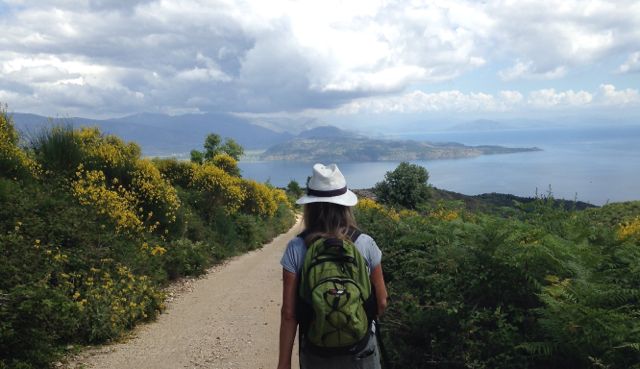

2.  If you want to do the whole thing go through Aperghi Travel, based in Corfu,  and they can organise it all for you from  booking your accommodation and transporting your bags day to day - they can also provide a guide to take groups.  We met one of these guides with his group, Spiro (of course!), high up in a mountain village and spent a happy half an hour or so over a Greek salad and tsitsibira (Corfiot ginger beer - a hangover from British rule - like cricket on the green) discussing the wild flowers we had seen that day and if I knew what a particular stem-clasping sage was? (Spiro, if you are ever looking at this, Smyrnium rotundifolium - I think)


Our Greek not up to scratch for some of the signposting
Walk 1:  From PORTO to OLD PERITHEA via the highest peak on Corfu - PANTOKRATOR (980m).  What magnificent views of the Albanian coastline, heady fragrance of all the wildflowers - too many varieties to count - and the air abuzz with so many insects and butterflies. The way not clearly marked and we took a wrong turn finding ourselves heading down to the coast instead of inland.  Had a fortunate encounter with some other walkers - the only people we saw that day - who put us right and told us we should have turned up behind the goat shed!

Backtracked about 4km and eventually found our way to the base of Pantokrator and the ruined village of Old Perithea - once the capital of Corfu in the 14th century and now a village of 130 ruined stone buildings - which are gradually being restored - with, thankfully, four working tavernas, being a regular stopping off point for those climbing to the summit.


Old Perithea


Wandered around happily among the ruins, donkeys, chickens and burgeoning vegetable gardens with people starting to reinhabit this tranquil place - there is even a 4star B&B, The Merchant's House.  With lunch under our belt we headed back to Porto and our hire car parked in the grounds of the old church.

About 12km round trip and an absolutely wonderful day's walking.


Walk 2: SPARTILAS to PANDOKRATORAS IPSILOU (ruined church) with wonderful views down the coastline to IPSOU and DASIA. 


The comment in my diary after this hike was "The Corfu Trail is either going to turn me into an Olympian or a hospital case - I suspect the latter". This was a challenging walk that climbed and descended steeply - often clambering over large boulders.  What it did though was give us spectacular views of the coastline to the south and Corfu Town and across the Ionian sea to Epirus (Albania and Greece) and the Pindus mountains - which I am dying to go and explore.

The absolutely best thing about walking is that you leave the madding crowd behind - you rarely meet a soul.  Corfu has long-been a mecca for British package tourists, Italian holidaymakers and cruise trip day-trippers, which can be really overwhelming in the town and resorts but, up here, you have it all to yourself and it's heaven.

Walk 3: SOKRAKI  to VALANIO and the waterfall at NIMFES through ancient olive groves and holm oak forests.

Having taken the advice of Spiro, the walking guide we had met the previous day, we set out to do a circular walk  to some of the northern inland villages that started in SOKRAKI - a two donkey wide village where the locals gave all sorts of advice about where the Corfu Trail might start - none of it helpful - eventually being put right by olive wood turner, whom we spotted in a little workshop (Spiro!!) who spoke good English.

We were headed for some of the loveliest and remotest villages on Corfu that are full of myth and legend, walking past groves of flowering orange and almond trees.


Such a contrast to the previous walks - now in quite dense shade from towering olive trees - some over 7m - marvellously gnarled, mossy and full of fist-like holes.  Everywhere else we have ever been in Greece - from the Peleponnese to Santorini - the olive trees are radically and regularly pruned, but not on Corfu and I don't know why? Spotted many new species of  wildflowers, butterflies and birds (and lots of shotgun cartridges!).  After, what we thought was going to be a 6km walk which turned into 10km, and getting lost again, we just about made it to the village of Horepiskopi before a sudden and torrential downpour shrouded the valley in a veil of mist.  We just made it in time to the local cafe before the rain came down in drenching sheets. Thankfully dry, and with a spanakopita and coffee inside us, we called it a day and got a taxi back to our car.  It cost us 25 euros but, I think I would have paid 100! 

Walk 4: NISSAKI TO KALAMI coastal walk past the Durrell White House

Started in the very pretty bay of Kaminaki, next to where we were staying at Nissaki, and took the Corfu Trail past some lovely bays and coastal headlands  ending up at Kalami where Lawrence Durrell lived with his wife in the White House.  It's still there - has a taverna underneath and been turned into a guest house.  

Kaminaki
This whole coastline has long been the playground of a certain kind of holidaying Brit and is known as Kensington on Sea - I spotted the first cravat I have seen in a long while.  It has also been a permanent home to many of them - just like the Durrells - who were refugees from a post colonial era, not being able to settle in Britain after their birth-lands gained independence when the Empire crumbled.  The poignancy of this struck me when I was wandering around the British Cemetery in Corfu Town - just how many of those British people who had ultimately called Corfu home and subsequently died there, had been born in the far-flung corners of the Empire like India or Malaya - just like Ma Durrell - or maybe they just couldn't stand the weather in Britain after living in places with heat.

Kalami
This is a marvellous 'swimming' and 'boating' coastline dotted with azure bays and climbing cliffs punctuated with cypress and olive trees.  The ruggedness of the coastline also means that the road stays at the top and you can only get to the more secluded bays on foot or by boat - just the way I like it.  Ended up for lunch in the bay of Agni - which has three tavernas with most folk arrive by boat which get parked by the jetty boys employed by these very busy tavernas  One of them is famously run by Theo (Taverna Agni) and we were advised to go and chat to him about nipping over to the mainland as he conducts trips there focussing on food.  Unfortunately, the day we picked he was way too busy to chat so we just had to be content with quick lunch, cold drink and make our way back to Nissaki for a well-earned siesta.  Epirus will have to wait for another time.

We had dinner to look forward to at our taverna at Nissaki - 'Mitsos' run by Agatha and her family.

Best homemade taramasalata (she made it with finely sieved potato instead of bread), meatballs and daily specials - here we were having gavros (fresh anchovies) - my favourite.

I'm not a fan of chips, but she made the best, crispy with creamy yellow flesh.  The half litre of local white wine was cold and good too AND the very best meatballs in tomato sauce.  Unlike most Greek food these are spicy with chilli and cinnamon.


Walk 5: AGIOS GEORGIOS to PALEOKASTRITSA MONASTERY


Paleokrastitsa


When we asked our fellow Trail walker, Karen, what had been the highlight of her journey on the Corfu Trail, she nominated this walk for the fantastic coastal views - and she was not wrong.  PALEOKASTRISTSA has a series of stunning cypress studied bays that fall down to spectacular rocky coves and beaches with mouthwash sea all a'bob with impressive looking yachts flying the colours of every nation.  The downside is that the hillsides and beaches are crammed with holiday villas and tourists, with bus loads of day-trippers heading for the historic Theotokas monastery dedicated to the Virgin Mary and dating from 1228.


The monastery is well worth a visit, if you can find a quiet time - it has a beautiful garden, olive press in a cave and stunning iconography and adornments in the church.  We were there on a day when coach loads of Orthodox Russian tourists had arrived from a visiting cruise ship in Corfu harbour.  Crammed into queuing behind them I was transfixed as the women shrouded themselves in headscarves, kissed the icon of the Virgin Mary and genuflected so low that their hair swept the floor, back and forth several times.


There is also something else that attracts visitors - the bay of Paleokastritsa is steeped in Homeric myth and supposed to be the place where Odysseus' ship was wrecked (the rocky headlands said to resemble the ship) and, in his nakedness, where he first clapped eyes on Nausikaa.
Odysseus and Nausicaa from the collection of paintings held at the Achilleion Palace, Corfu 
(This palace, built by the Empress of Austria in 1890, and dedicated to the mythical hero Achilles, is somewhere else that is well worth a visit)

We bolted for the inland village of LIAPADES to escape the wind that had blown-up from the sea.  This is a lovely traditional village and contains everything, according to Lawrence Durrell, that a  village should - a square with a church, a kafenion (cafe), and a Tree of Idleness for shade.  Where these are absent - according to Hilary Whitton Paipeti (maker of the Corfu Trail and Trail notes) - the lifestyle perishes and the village is no longer a village. (Sign on the bottom of the menu, Liapades Kafenion "The shop is obliged to have printed documents in a special case beside the exit for setting out of any existed complaint" - we didn't have any!)


Walk 6: THE ENGLISH CEMETARY, Corfu Town

If you are staying in Corfu Town there are many places of interest that you can walk to including the English Cemetery; The Old and New Fortress, the Old Port and cobbled backstreets, the produce market in the old moat, Mon Repos (villa where Prince Phillip was born) Achilleon Palace (a short bus ride), the Esplanade and Liston (catch a cricket match on Sunday afternoons) and a fine Archeological Museum.

We took a walk, in the fading evening light, to the English Cemetery which I had seen featured on a travel series on DVD by Joanna Lumley called Greek Odyssey.  I loved the genuine passion she showed for Greece and some of the out-of-the-way places she visited and shared - not the regular journey that these kind of shows normally take.  For an overview of Greece, I highly recommend it.

This graveyard is overseen by George Psailas who was born in the gatehouse of the cemetery in 1927 - his father was the gardener before him - and he has lived here ever since taking pride in its special beauty and history.  This place tells many stories - of battles won and lost and soldiers buried far from home and all the British expatriates who, for the past two hundred years, have called Corfu home.  It is also a garden of wistful beauty and contains many wild and cultivated flowers.  Out of 200 orchid species found in Europe, 30 can be found in here.  George was awarded the Empire Medal for his dedication to the upkeep of the cemetery and he showed the plot he has already chosen for his final resting place - with the best view of the garden.  Here's something he had to say.  "If all people loved flowers we would never have wars.  It may seem incredible, but it is very true.  For 67 years I have been living, night and day, in a piece of land where our beloved persons rest for ever in peace, without disturbing anyone, without claiming anything.  However, the nature, 'Mother Earth', offers them her best jewel, the various flowers of the seasons: daisies, iris, orchids, cyclamen, saffrons, snowdrops and many others.  The loveliest thing in the world is a flower - don't look for beauty anywhere else"

NOTE:  Something about Corfiot cuisine

Being a lover of Greek food I was intrigued to find something a bit different on Corfu - food that is inextricably linked with its geography and history and is reflected in some specialities flavoured with cinnamon and nutmeg and spiced up with chilli.  Here are a few to watch out for:

Clinging to every rock face and an important part of Greek cuisine - capers and samphire - we are in the land of hunter gatherers!

BOURDETO  A fish stew, usually made from scorpion fish, in a tomato based sauce and flavoured with red pepper, both hot and sweet.

PASTITSATHA  Rooster cooked in cinnamon, cloves, nutmeg and paprika and served with pasta. 

AVGOTARAHO  Smoked fish roe from PETRITI on the south coast is one of the gourmet treats - like botargo - it is the salted , sun-dried roe of the grey mullet.  The Corfiots preserve it by coating it in beeswax.  A delicacy, like caviar, it's usually sliced thinly and served with olive oil, pepper and lemon and paired with fruits such as dried figs. 

SOFRITO Veal cooked in wine sauce with garlic and white pepper

TSIGARELI In the horta tradition of wild greens, they sauté them on Corfu (usually chard) with onion, garlic, olive oil, chopped fennel leaves and red pepper.  This was a favourite and we had this most days.  Not being a fan of 'greens' this was an absolute first for me - so tender, not stringy, and delicious.  An important part of the Mediterranean diet, wild greens can come in many shapes and sizes and it's often hard, for a non-speaker,  to pin down what it actually is and can be; chicory, lambs lettuce, dandelion, chard, silver beet, samphire, beetroot tops and even leaves from the tamarisk tree - to name but a few.  They are always served with fresh lemon and olive oil.
We had many memorable meals, but one of the best was at a cliffside restaurant in the north-east, Caryatids.  There we had a typically Corfiot meal of octopus stew, spiced with paprika and cinnamon, accompanied by local potaoes, creamed and flavoured with nutmeg. Oh, and don't forget the nod to the neighbours with an Italian salad, insalata caprese - local tomatoes and cheese with fresh basil.  Yum - and I can't wait to go back. 


"Other countries may offer you discoveries in manners or lore or landscape; Greece offers you something harder - the discovery of yourself"
Larence Durrell, Prospero's Cell, written on Corfu in 1939

Sunday, April 19, 2015

Crostata - Rustic Fruit Pie

Crostata  As its name suggests this dish has its home in Italy and is a very simple way to make a pie without too much fuss - with very little rolling and cutting out of pastry.

Crostata with plums and strawberries - you can see where the rustic comes from!

I first came across this pie in a pastry making demonstration by Belinda Jeffery - food writer and pastry cook extraordinaire - my skills are decidedly lacking so I decided to pay some attention and see if some of hers would rub off on me.  Since then, crostatas have regularly been rolled out for the family especially during the stone fruit season - it's a particularly delightful pie with plums, apricots or rhubarb, but you can make it with apples, pears with any kind of berries added.

The fruit sits on a base of crushed nuts and brown sugar - the nutmeal can be almond, pistachio, macadamia or hazelnut - which soaks up any juices from the fruit, stops the pastry from going soggy and adds an extra yumminess to the pie.  Belinda makes hers with crushed amoretti biscuits and I have also made it with crushed digestive biscuits when I didn't have any nuts to hand.

Pastry
1 1/2 cups plain flour (I use wholemeal)
! tbsp caster sugar
125g cold unsalted butter
1 egg yolk (save the white for glazing the pie)
Good pinch of salt

2 tbsp nutmeal (see above)
1 tbsp brown sugar
1 tsp ground cinnamon

l kg of fresh fruit, stoned and cut into quarters (see above)
Extra sugar if the fruit is particularly tart

1.  To make pastry, put flour, butter, sugar, salt in food processor and whizz together until mixture resembles breadcrumbs.  With processor running add egg yolk and keep going until mixture forms into a ball.  Depending on size of egg yolks you may also need to add a small amount of iced water.

2.  Turn dough out onto floured board and form into a ball, then flatten into a disc and wrap in plastic film.  Chill for about 30 minutes in the fridge.

3.  Preheat oven to 200oC.  Lightly grease a pizza tray.

4.  Mix together nutmeal, brown sugar and cinnamon and set aside.

5.  Remove pastry from fridge and roll out on pizza tray.  It doesn't have to be a perfect round.  Roll right to the edge.

6.  Place the nut/sugar mixture in the middle spreading it into a circle.  Place the fruit on top.

7.  Now you have to imagine that you are a child and drawing a picture of the sun with a knife from the fruit out to the edge of the pastry. Carefully flop it over the fruit in a random fashion - it should only have cover the fruit leaving the centre exposed.  Sprinkle extra sugar over the top of the fruit if needed.
NOTE:  It's important not to break the strips or make holes in the pastry otherwise all the fruit juices will seep out.

8.  Lightly beat the egg white and brush over the pastry - this will give it a golden colour.

   Place in oven and bake for 35-45 minutes - should be lightly golden.  Serve with cream or ice cream.

Saturday, April 4, 2015

Skordalia - Greek Potato Dip

This is another of those extremely simple dishes that beg for the best quality ingredients or it just won't taste that good.  I can already see a few people turning up their noses at the idea of a potato dip but, believe me, this is really a very tasty dish that's so simple to make.


It's one of those dishes that you will find all over Greece as part of a mezze platter or as an accompaniment to poached fish or roast lamb.  I made it the other day for the first time and tried it out on the family - this was Leila's (9) comment as she wiped the bowl clean "This is a winner Nanma - have you put it on the blog yet"?

NOTE: Very important - the potatoes have to be the non-waxy variety that you can mash to a very smooth paste - Desiree or Royal Blue are perfect.

Royal Blue potatoes.  I am in love with these - they just have the most fabulous texture for roasting and you can get them really crispy.

600g potatoes  Cooked whole and then peeled
2 cloves garlic, crushed
Juice of 1 lemon - about 1/4 cup
Sea salt
1/2 - 3/4 cup good extra virgin olive oil
A tray of Royal Blues I was preparing for roasting - par-boiled first and finished off in a high oven with duck fat and rosemary.  You can see their yellow rich texture.

METHOD
Blend together the cooked and peeled potatoes with all the ingredients to a smooth consistency.  (In restaurants they put the potatoes through a ricer - I don't have one, but I find it works just as well like this).  That's it!

TO SERVE
As part of a mezze plate I serve them with toasted pita bread (stale is best) or crudités (raw vegetable sticks).

NOTE:  Skordalia  (σκορδαλιά).  Another way to serve this, which is also very common in Greece, is not with potatoes but with stale bread that has been soaked in water and ground almonds or walnuts - again to make a thick paste with lemon juice, garlic and olive oil.

Friday, March 27, 2015

Dirty Politics, Dirty Power and Dirty Chemicals


Three things have happened this week that have driven me to get my thoughts down on the page and hopefully this information shared will help you decide where  you will spend your dollar and who you will give your vote to.  Purse power, consumer consciousness and social media are real and powerful agents for change.

LITTLE STORY ONE:  At the post screening Q&A of the film 'Frackman' in Sydney this week Dayne Pratzky a.k.a Frackman the anti Coal Seem Gas activist,  said that we have two powerful means of effecting change in our society RIGHT HERE AND NOW - CHANGE BANKS and CHANGE POWER COMPANIES because they are not serving us, the environment or the future well - they do not have our interests at heart.  He asked us to look around the room and do a quick estimate of how much money we had invested or mortgaged to the big banks? A few million dollars suddenly invested in a more ethical provider is INSTANTLY going to make the big five sit up and think.   

DIRTY POWER and DIRTY POLITICS: We have a State election tomorrow and a huge debating point in the lead-up has been soaring energy prices and the lack of commitment to renewable energy targets (RET) by the major parties and the federal coalition government led by Tony Abbott - where he is actually leading us doesn't really bear thinking about.  Yesterday a GetUp campaign to switch to the NZ power company Powershop was endorsed by a former leader of the Liberal Party, John Hewson - it makes for powerful and interesting reading.  Maybe he too, like Malcolm Fraser, he has outgrown his party?


LITTLE STORY TWO:  Coincidentally I have, this week, been doing a survey of my neighbours to find out who their energy supplier was, how much they were paying and if they were interested in switching to a cheaper and greener supplier?  Then I got this from GetUp and found Powershop.  When I got back to our energy provider, Origin, and told them  that myself and 5 neighbours were switching to Powershop because of their cheaper pricing and green credentials they immediately offered my a 30% reduction on my bill!!  PURSE POWER!! - I  had great delight in telling them where to stick their power poles and their company.
Our recently retired and well respected Governor of NSW, Marie Bashir, also made a scathing attack on Government policy this week saying  the destruction of fertile Australian farmland for mining is a "crisis" that must stop, adding: "I have never been so emphatic or political in my life".

DIRTY CHEMICALS:
Roundup (glyphosate) is a broad spectrum weedkiller that has made the chemical giant Monsanto extremely wealthy. For the first time glyphosate has been listed by the International Agency for Cancer Research (IARC), which is part of the WHO, as a 'probable human carcinogen'. This was reported in the latest edition of the Lancet Oncology.

A probable finding is very serious as not many things can be proven beyond doubt to cause cancer (remember tobacco?) so this is only one step down from that in terms of the IARC classifications.


London street artist Louis Masai Michell telling it how it is.  Declining bee numbers throughout the world have reached crisis point.

As you would expect there will be much that Monsanto has to say about this but, if past revelations are anything to go by, their favourite tactic is to shoot the messenger and destroy their reputations. IARC is the independent, scientific authority on cancer classifications.

LITTLE STORY THREE: Many years ago I was asked to give a talk to a local gardening club about Genetic Modification of crops - or GM.  This was when it first came into the news and these gardeners wanted my to try and explain to them what it was all about.  In the course of my research I discovered some startling things - here is one example from the early days of GM in the US:
Genetically modified corn was engineered (by Monsanto) to withstand the weedkiller glyphosate.  This enabled farmers to blanket spray their crops - the weeds would die and the crops survive.  I remember a question from a member of the audience "How can eating food that has been sprayed with weed killer be good for you" - common sense tells you that it's not, it's just makes it cheaper and feeds the obese giant that is the industrial food industry.  Here is just one example how this radical and thoughtless destruction breaks the chain in the delicate cycle of life.   Increased use of GM crops and agricultural chemicals has almost totally wiped out the monarch butterfly, that was once a common sight in many parts or rural USA.  They feed on flowering crops and are pollinated by a weed that was being killed chemical spraying. - and now we have proof that it was killing us too. 

LITTLE STORY FOUR:  I had a young family friend, her husband and baby visit the other day and she was proudly telling me about the raised veggie bed they had put in and that they had covered it in mesh 'to keep the bugs out'.  When I asked them how anything would get pollinated and how she would actually get any vegetables - beans, eggplant, zucchini,  a look of total amazement passed between them.  In all my years of teaching gardening classes I'm constantly stunned by how much we DON'T KNOW about the world around us - educated people - about the fundamentally important things that make this beautiful planet of ours tick.


VOTE GREEN, SWITCH POWER COMPANIES, CHANGE BANKS, DON'T SPRAY and PLANT A GARDEN.  That's not much of shopping list for the week?

Wednesday, March 18, 2015

Meringue - top tips for perfection!

It has taken me 40 years of trial and error, mostly error, to finally get this right so I thought I would pass on what I have learned about making the perfect meringues - it's really easy, once you know how - and it's really worth it!!


This all started because we were having a party and I had to make dessert for about 40 people - and I don't have a spare fridge.  It is forty years since we came to Australia with a suitcase, an eight month old and a dream for a brighter future!  We thought this was worth celebrating and I think that it is always the right time to be grateful - so party time it was!

Anyway, it was damn hot and numbers for party still very fluid - what to make?  This is where meringues come into their own.  WHY? They can be made in advance (up to three weeks), can be in any shape or size you like AND THEY DON'T HAVE TO BE KEPT IN THE FRIDGE - any airtight container will do, and you can, on the night, turn them into something impressive and delicious with a bit of fresh fruit and some whipped cream.  They were also in keeping with our Aussie theme - pavlova being a traditional Australian dessert - these were just going to be hand held ones to reduce the washing up.

MY TOP TIPS FOR MAKING MERINGUES
  1. Use the freshest eggs you can lay your hands on (cluck, cluck!)
  2. Have them at room temperature.
  3. Use very clean and dry utensils and don't mix in a plastic bowl (they absorb grease - which is bad for meringue making).
  4. Make sure the sugar is lump free.
  5. When you are separating the eggs, make sure that not a skerrick of yolk gets into the white.
And most important of all - DON'T OVER-BEAT.  This is actually your secret to success and where I have gone wrong before. Over-beating usually means that the meringues will end up soft and chewy with globules of caramelised sugar on the outside, instead of crisp and crunchy on the outside and a bit chewy in the middle.


Ingredients (this will make 15-20 depending on size)
4 egg whites
220g caster sugar
pinch of salt

Method
1.  Turn oven on to 150oC.
2.  Whip egg whites - electric hand-beater is best - until they begin to form soft peaks - now STOP beating.
3.  In a steady stream - with beaters on low - pour the sugar slowly into the egg whites (this is where an eager grandchild with a promise of post bowl-licking comes in handy!).
4.  When the sugar is combined, increase the speed to high and whip again until soft peaks form then STOP.  It doesn't matter if the meringue is still a bit grainy from the sugar.
5.  Spoon onto trays lined with baking paper (what did we do without this stuff?)
6.  Make a little nest in the middle to later accommodate cream/fruit/grated chocolate filling.
7.  Bake in oven for 35-45 minutes.  Meringues should be firm to touch.  Turn off oven, open door and leave meringues in oven to cool.
8.  When completely cool, store in airtight container until needed.


Serve with whipped cream and fruit.  Last year for Easter I thought I would do a different take on Easter eggs and made 'egg' meringues with poached peaches and passionfruit - they were pretty good.  For the party we had them with strawberries and mango - a bit of chocolate flake on top would have been even better.


Easter meringue eggs.  This batch were not as good as the perfected recipe above - they broke up really easily - not that anybody complained.

I have very few gadgets in my kitchen but one I couldn't do without is a simple electric hand beater.  This one was bought for me as a wedding present 43 years ago and has certainly seen a lot of whipping and beating, but finally telling me its' sentence was served and going up in a puff of smoke during its' last outing.  My knew one has an LCD display panel, timer, 14 speeds and very annoying beeping - can anybody tell me if this is progress and I seriously doubt that it will last for 43 years but, then again, I won't either.


My 43 year old Phillips electric beater - sadly now deceased.  I wonder if anyone has an older working appliance?

TOP TIPS FOR MERINGUE
  • Make them any size you want!  They can be the size of a plate and piled up to make a pavlova.
  • We recently went to a Turkish film and dinner night at our local community hall and my clever friend, the chef, had turned meringue into tiny minarets - stunning and yummy!
  • Heard of Eton mess?  Well, it's just broken up meringue, fresh berries and whipped cream in a glass dish - easy eh!
  • And don't worry about wasting the left-over egg yolks - turn them into: omelette, fritata, creme caramel or custard for trifle.

Monday, February 16, 2015

Climbing Plants - Greening Vertical Spaces

The vertical spaces in a landscape are often ignored, but when you walk into a garden that has used climbing plants wisely, another dimension is added that is often breathtakingly beautiful,  that lifts they eye and heart 'upwards' and 'over' instead of just 'along'.

Pyrostegia venusta - used in my neighbours' garden to cover an ugly fence and create a self-supporting archway.  This is a good climber to use if you want a plant that is green from the ground up - often climbers have bare stems at ground level.  Beware - this plant is very vigorous and needs diligent maintenance.

One modern incarnation of vertical landscaping is the increasing popularity of green walls in our cities and urban spaces -  where architects are beginning to realise not only the environmental benefits of greening whole buildings, including roof spaces, but also the beneficial impact of their visual beauty.

Gardens of the Acropolis Museum, Athens.  This otherwise ugly wall in the background building formed part of the boundary of new Museum gardens - what to do with something like this sticking out like a sore thumb - green it.

Climbing Plants for the Home Garden
Success with climbing plants comes with an understanding of how they climb - do they twine, do they have tendrils or suckers, do they scramble and have thorns, and then matching the right plant with the correct structure for them to climb over  - this is your key to success.  


Epiphytic orchids (they don't need soil!) used to create an arbour - to stunning effect - in the Singapore Botanic Gardens.  Who would have thought to use orchids in this way? (You could do the same with small bromeliads - they are also epiphytic)

For example.  Plants with tendrils; Passiflora sp. (Passion flower and fruit), Pyrostegia venusta (Orange trumpet creeper) and everything in the climbing peas won't grow just up a pole - their tendrils need something to cling onto.  Conversely, plants that like to twine need a pole to climb up and won't be very happy with a piece of mesh, these include: Wistaria sinensis (Wisteria) Vigna carracalla (Snail Vine) and Trachelospermum jasminoides (Star jasmine).  Then we have the scramblers - often with thorns - these need a wall or arbour to climb over or against and constant attention to keep them in check e.g. climbing roses and bougainvillea.  So, one size does not fit all!

Three different ways I have used climbers in my garden:
Passionfruit (Passiflora edulis).These are climbing plants with tendrils that need support to cling on to.  I needed something to reduce the amount of sunlight coming into my bedroom and in our outdoor dining area, which is next to it.  I chose Passionfruit because; it has tendrils so I could train it to go exactly where I wanted it to, a clear trunk at the bottom that would not impact on the rest of the garden bed, it has lovely glossy green foliage, beautiful flowers and the added bonus of delicious fruit.  I simply tacked some plastic lattice to the underside of the eaves where I wanted the vine to grow - the tendrils did the rest!


Snail Vine (Vigna carracalla) . This is a twining plant - like every climber in the bean family.  What I needed for this job was a plant that would twine itself over an arbour that leads down to the lower part of the garden.  I wanted something that was really beautiful, preferably with a fragrance, because this is a focal point in the garden, and not too vigorous - i.e. something I could control because the frame of the archway is quite small.  This is where deciduous climbers come into their own.  Because they loose their leaves in winter they give a seasonal shape to the garden and also makes them easy to prune to the desired shape.  PS this plant has the most gorgeous fragrance and the stunning flowers really do look like little snails.

Use of deciduous plants -  lightbulb moment: I actually really got switched on to the joy of gardening when I was sitting in a class, right at the beginning of my horticultural studies, and we were exploring the use of all kinds of deciduous plants and realised that you could use plants, not only for their beauty, but for passive light and heat control.  Think of a beautiful wisteria vine over a pergola in summer providing a cool, shaded and scented place to sit, and then in winter allowing the light and heat of the winter sun to penetrate through its bare stems.


Bougainvillea: These are scramblers with arching canes and hooked thorns - they need support.  I have a brick pathway that leads to the back of the house so I wanted to create a beautiful entranceway that lead they eye to the back garden, and something that I could  train with horizontal supporting wires, keep flat against the wall and that wouldn't impede the path.  (This is the garden art of espaliering - often used to train trees and shrubs flat against the side of a building or as a living fence).

It was also facing west so keeps pretty hot and perfect for a bougainvillea - flowering for most of the year - and I could have my favourite Scarlet O'Hara.

To maintain it I just have to cut off any stems that are poking out at right angles over the path, and any that are climbing onto the roof.

To encourage repeat flowering: give a light prune after flowering; feed and water then but do not OVER WATER and FEED while it is in flower otherwise it will just put on a lot of foliage at the expense of the flowers. 

Because of their stunning flowers most people would dearly love to have a bougainvillea in their garden, but can I give you a few tips about where to plant them that I have learned from experience?

  • Only plant bougainvillea against a support.  DO NOT PLANT IT IN A SHRUB BORDER - because, before you know where you are, you will have a thirty foot thorned giant that nobody will want to deal with.  My son is an arborist and, from experience, refuses to take these monsters out for people who have randomly planted them and then regretted it.  We have both had nasty THORN experience!
  • Plant only in an OPEN, SUNNY position against a wall/fence that gets the hot afternoon sun otherwise THEY WILL NOT FLOWER
  • As with all climbers - PRUNE to shape right from the BEGINNING because it's hard to correct this once it is mature.
Bougainvillea make fantastic POT PLANTS and seem to thrive on being a little pot bound.  If you have ever been to Bali you will know what I mean because they have been used to stunning effect along the roads around the main airport.  They also graft really well and you can end up with an impressive specimen with several varieties on the same plant!


I wonder which came first - the door or the bougainvillea?

GREENING VERTICAL SPACES - How to choose the right plant?

Case Study - Jo and Justin's wall?

The Clients:  My young friends Jo and Justin have recently moved into an inner city terrace in Sydney, gutted the whole place and been renovating - no easy task with three children under five!  This is their tiny, narrow back yard dominated by a rear brick wall and bordered by a path that provides access to a side lane-way on the right.  It has good light - facing north-west.

They have already started to tackle the garden, laid some grass and put in a raised veggie bed and eventually they want to 'green the wall' - but at the moment it is being used for other purposes!  It's not an urgent job so they have plenty of important time to THINK about it.

What are the Constraints?
  • It has to be beautiful because it is the focal point of the whole house and garden.
  • Anything planted cannot grow out too far otherwise access along the back pathway will be compromised.
  • Cannot use anything not 'child friendly' i.e. noxious, allergenic or have thorns.
  • Preferably a useful plant (edible?) to maximise the limited space.
  • Must be suitable for their climatic zone (warm temperate/sub-tropical) - no square pegs in round holes please!


What are the Choices?
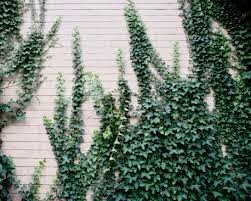
1.  Well, if you never wanted to paint the wall again you could use ivy - which has suckers along the stem that adhere themselves to the brickwork - that way you would not have to erect a support frame or wires. 

It is also a very hardy plant tolerating neglect however,  as you can see from this picture, it is not entirely maintenance-free and would require regular pruning to keep it flush against the wall.

Ivy (Hedera sp.) comes in variegations and different shades of green.


2.  Using espaliered citrus trees - thorn-free varieties - and maybe one for each of the children?  Plant selection is a matter of personal choice, but I would probably chose citrus varieties with smaller leaves (to give a denser cover) and definitely ones you are going to use e.g. lemon, lime, mandarin, kaffir lime, calamondin and cumquat.

These will require regular feeding and maintenance, but I think the rewards of creating a beautiful wall that is wonderfully fragrant in the springtime and provides an abundance of fruit might just outweigh that?

For a uniform effect the same species would have to be used (as in the lemon trees above), but you could use different kinds of citrus, just making sure that you planted the tallest in the middle.


3.  Star jasmine (Trachelospermum jasminoides) is a firm favourite with year round glossy, green leaves and a fantastic display of fragrant star-like flowers in the springtime.  This is a very hardy plant, tolerant of city pollution and easy to shape.

The stunning effect in the photo is easily achieved by stringing stainless steel wires from the ground up, to whatever height you want, then placing an individual plant at the bottom of every wire.

Of course it will need trimming and training to shape, but I know that Jo and Justin have a ladder!


4.  My last suggestion suitable for this situation is the fabulous Magnolia grandiflora - like the citrus suggestion these are not, in fact climbers, but can be used to grow flush against the side of a building again with espaliering techniques.  They have been used to stunning effect like this in European gardens for centuries and you will see them everywhere in the warmer Mediterranean countries greening the walls of glorious old buildings.
Again with glossy evergreen leaves, rusty coloured on the underside, they produce beautiful saucer-like, fragrant flowers with a heady citrus/gardenia perfume.

Certainly using a plant like this will require maintenance, but that is the case for whatever you chose.  Gardening is not like interior decorating - it is not 'finished' when it is finished!


Greening Vertical Spaces  - a summary. Choose the right plant and support for the situation (not the one that took your fancy at Bunnings!)

Thursday, February 5, 2015

Potato, pea and mint salad

One of the positive things about my passion for food is sharing recipes  with people - often in the most surprising of circumstances - and being connected to those people every time I cook up one of their dishes, but sometimes the boot is on the other foot!

I can't actually remember where I got this fantastic potato salad recipe from, but I know that it has become a real family 'go to' dish and that I have shared it with lots of other people - and sometimes being reminded of that in the most delightful way.


Sharing story 1: We had a few friends round for dinner the other night and just as I was serving up this potato salad a dinner guest said, "Di, have you seen this?"  He was browsing through a cook book given to me for Christmas by the author and my neighbour Belinda Jeffery - and there on page 30 was this recipe I had given her (acknowledged of course).  It's a fabulous cookbook and there isn't one dish I wouldn't want to try - and her pictures are much prettier than mine.


Potato, pea and mint salad
1 kilo of good waxy potatoes, boiled with their skin on until they are just cooked
1 cup of peas, steamed
1 bunch fresh mint leaves
1/2 cup sour cream
1/2 cup mayonnaise
Chopped spring onion, about a handful
Salt and pepper

1.  Put the cooked peas, sour cream, mint and mayonnaise in a blender and process until combined.
2.  Put the cubed potatoes in a serving bowl with the sliced spring onion
3.  Add the pea mixture with some salt and pepper.  That's it.  Nutritious and simple

(Belinda added topped it with some crispy bacon - also yummy!)

Sharing story 2:  I was visiting Sydney the other day and doing what I usually do - going for a swim - this time at one of my favourite places, Bronte Beach. It's now nine years since I moved away, but there are still many familiar faces sitting around the ocean pool and one of them is Fireman John - a retired fireman who has been swimming there for as long as I have.  We got chatting and I found out, sadly, that his wife Jan had died last year.  Now John is in his seventies and one of the things that he had never done is cook and now he has to - and I must say with a great sense of achievement and a little pride.  He told me that he used to tell his wife "You do the shopping, I'll pay for it and then I'll eat it".  Now he was telling me that he had cooked a batch of blueberry and walnut muffins before he came out because he had the family coming round for tea.  Anyway, I thought he would like this recipe - most men like potatoes - and it goes with lots of things so I wrote it on the only piece of paper I had in my bag - an old shopping docket.  I was thrilled to get this text a couple of days later.  "Hi Di, made potato salad using your recipe and included some bacon pieces and a few boiled eggs for show - everyone loved it"!


Bronte Beach, Sydney

Thursday, January 8, 2015

Gravalax - home cured salmon

A big welcome to all me readers, faithfuls and first-timers for a wonderfully happy and healthy 2015 with fabulous food and gorgeous gardens.  I think that probably a good way to start it off is with my horoscope for the year that a friend sent on to me  - she knows me very well!

Gemini 2015:  "You've tried being normal, that didn't work - now just be yourself"


Home made gravalax is a dish that never fails to impress, and yet it is so simple to make, wonderfully versatile and simply delicious to eat.  Coming from the Nordic culture of food preservation it is traditionally served on rye bread with a mustard and dill sauce.


It was our annual street party last night that involves taking a chair, a bottle of something cold and a plate of food to share,  so I decided on some blinis - little leavened pikelets topped with cured salmon and sour cream.

How to make Gravalax?
500g thick cut, fresh salmon with the skin on - you can use fresh trout too.
1/4 cup of vodka
1 bunch of dill or fennel fronds roughly cut
1/3 cup sea salt
1/3 cup brown sugar


1. Mix the curing ingredients together in a non-reactive dish
2. Lay the salmon in, skin side up
3. Cover in cling film and weight it down with something heavy on top.  Leave overnight.
4. In the morning, turn the fish over and return to fridge for another few hours.  Don't leave longer than 24 hours.
5. When you are ready to use it, scrape the fish clean and dab with paper towel to remove any excess curing stuff.  DO NOT WASH!
6. Cut into thin slices down towards the skin.  Left whole will keep for up to a week in the fridge.
NOTE:  You may need to remove any bones with a pair of tweezers - I find this easier to do after it has been cured.  After curing the salmon will take on a richer colour, firmer texture and more translucent quality - as you can see!
TOP TIP:  For an even more sensational colour - add some grated fresh beetroot to the curing mix.


How to Make Blinis?
1/2 cup buckwheat flour - can use wholemeal or rye
1/2 cup strong white flour
1 egg
About one cup of milk - can be buttermilk or mixture of milk and yoghurt
Salt to taste
1 tsp yeast

1.  Mix everything together and leave to rise for 1-2 hours in a warm place - should be a spongy batter
2.  Heat non-stick pan and add a little butter
3.  Cook in small batches, using small spoonfuls, until lightly golden on both sides.
NOTE:  Blinis are a traditional Russian dish, originally served with caviar and sour cream.

Assemble topped with little dollops of sour cream mixed with capers and chopped dill.  I actually used pickled nasturtium seeds - they have wonderfully pungent taste - a bit like horseradish, which is the traditional topping for salmon blinis but mostly unavailable where I live.  Anyway, they tasted sensational and were gone in about five minutes!


NOTE:  Curing salmon this way gives you something very versatile, economical and yummy to keep in your fridge to have on sandwiches or turn into a sophisticated salad - my favourite being with warm potatoes, chopped spring onions, hard boiled eggs and a salad dressing laced with mustard and pickled nasturtium seeds - oh, I forgot, a sprinkle of dill.

Sunday, December 7, 2014

Kasundi - Spiced Tomato Relish


I first posted the recipe for a version of kasundi about three years ago - when it was totally knew to me - and hooked on it's spicy yumminess I have made it many times since.  With Christmas around the corner and a need for something delicious to go with all those leftovers AND a top homemade gift, I decided to give it another go - with my usual 'tweaking' of the ingredients to see if I could improve upon the first recipe; the taste of which was great, but I found the consistency a bit runny - by blending the garlic, chillies and ginger first to make a thick paste I found it remarkably improved.


If there is one thing I have learned about living in the sub-tropics it's about growing tomatoes - unlike every other place I have lived in - they are not a summer crop here; too wet, too hot and too many bugs, but find a the right spot in your garden and you can grow them for a good nine months of the year, right through winter, until late spring.  I harvested the last of my crop for the kasundi, but you can just as easily use canned tomatoes.


The taste is fabulous - rich, pungent and spicy and great with eggs, curries and rice dishes - and especially pakoras (Indian vegetable fritters) Easy to make this relish will keep, unopened in the fridge, for six months or more. The quantity of the ingredients may seem a little excessive - have faith, it works!  I thought the number of chilles was going to make it far too hot so included less to start with - I ended up adding more because it wasn't pungent enough - 30 it is!


4tbs peanut oil - or other vegetable oil (not olive)

4tbs black mustard seed
2 tbsp turmeric powder
4 tbsp ground cumin
30 small green chillies, seeds removed
NOTE: Do this with disposable gloves on!
12 garlic cloves, peeled
125g fresh ginger, peeled and chopped
1 1/2 kg ripe tomatoes, chopped (or canned)
1tbs salt, approx.
250ml malt vinegar
125g brown sugar 
4 tbsp smoked paprika

Method

1.  Place the ginger, garlic, chillies and 50ml of the vinegar in a food processor and puree to smooth paste.
2.  Heat the oil in a wok, add the dry spices and cook on a medium heat for five minutes - being careful not to burn them.
3.  Add the ginger paste and cook for further five minutes.
4.  Add tomatoes, sugar, salt and remaining vinegar and simmer for about an hour.  When the oil comes to the top it is ready.

Kasundi is the perfect accompaniment to homemade cauliflower and eggplant pakoras.  Check out the recipe. Having people over - then this is the perfect snack with a glass of something cold.

Friday, November 14, 2014

Pasta with tuna, lemon and rocket - singing pasta

This pasta dish is one of those things you can go to when you haven't got anything for dinner as you will find that you probably do have most of the ingredients anyway; those staples in the pantry like canned tuna, spaghetti, frozen peas and a lemon.

It's become my standby dish and everyone loves it anyway - it's in the top ten requests from the family - and so quick and easy to make.

As spring has sprung in the garden I would rather be out there than slaving away in the kitchen and singing pasta has become my standard 'after a day in the garden' dish - satisfying, tasty and easy.

I first saw a variation of this, many years ago, in a Qantas inflight magazine by and Australian woman who ran a cooking school in Florence.  This is what she served the arriving participants.

Like all simple dishes it's the quality of the ingredients that counts - which seems to have filtered down to my children as my son-in-law recently told me that he very quickly learned that only Sirena tuna and Barilla pasta should go in the trolley when he was doing the shopping.  (He also now knows to buy local Australian extra virgin olive oil and check the date when it was pressed - fresh is best!).  When I actually think about this it's mildly scary - have I become one of THOSE mothers and mother-in-laws?

Why singing pasta?  Well, the flavours sing in your mouth; the zing of the lemon, sweetness of the peas, hit from the chilli and the rocket just cuts through the oily flavour with it's slight bitter edge.

What you will need for 4 people:
400 g can Sirena tuna in oil
500 g packet Barilla pasta No5 (or any other good quality dried pasta - don't use fresh for this)
1 cup frozen peas
Zest and juice of one fresh lemon
Fresh rocket, about a handful
White whine, about half a cup
Extra virgin olive oil, about a quarter of a cup
Parmesan cheese, finely grated
NOTE:  This is one of those dishes that breaks the unwritten rule of no parmesan in pasta dishes with fish - see what you think?

Optional extras which I nearly always add; capers (I use pickled nasturtium seeds as a substitute) and a finely sliced red chilli - because I like chilli in everything.

Method:
1.  Put on a large pot of salted water for the pasta.  When it is boiling add the spaghetti and cook until al dente.
2.  Put the tuna, zest of lemon (reserve the juice), wine and oil in a saucepan and bring to simmer - add capers and chilli at this stage too.  
3.  Add peas and heat through.  DONE.  Don't overcook.
4.  Place the fresh rocket in the bottom of the colander and strain the pasta over it - the idea is to just wilt it.  Flick the rocket through the spaghetti with a fork.  Tip into a wide serving dish.
5.  Adjust seasoning of tuna mix - may need extra salt - and pour over pasta and stir through.
6.  Squeeze over lemon juice and top with finely grated parmesan cheese.

Am sure that this would taste even better on a balcony in Florence with a view over the Duomo but buon appetito anyway.

Monday, November 3, 2014

Elderflower Champagne

I don't know if you have ever used yourself as a guinea pig - well I'm doing that right now and feeling decidedly squiffy!  I am trying the first batch of my elderflower champagne and it tastes pretty sensational.  If this post trails off you know I have keeled over!


I am fascinated by all things that can be made by hunting and gathering ie FOR FREE and, in this case, a delightful and refreshing bubbly drink (alcoholic?) made from flowers growing in every wild hedgerow in my neck of the woods and, I suspect, in many other parts of the world too.  Elderberry was certainly part of every hedgerow when I was growing up in the UK and seems to be having a revival with elderflower cordial cropping up all over the place in food articles and celebrity chef programs - it has a distinctive and delightful taste.  I think too that it is all part of the challenge and thrill of making something fantastic from wild food - I know for certain that it is deeply embedded in my DNA.

The Elderberry bush (Sambucas nigra) has long been used for making all manner of drinks, jams and relishes but I was inspired to make this after watching a episode of the TV program of River Cottage with the fantastically resourceful British gardener and chef Hugh Fernley Whittingstall.

On a brief look through my cook books I have found at least 30 recipes for using either Elderberry flowers, buds, green fruit or mature purple fruit.  Elderberry wine was certainly a common tipple in post-war Britain and my father was a master 'weird' wine-maker with earthen-ware crock pots bubbling away in our airing cupboard full of the next toxic brew.  Maybe he was just looking, like me, for the challenge of making something for nothing but I vividly remember tastings of tealeaf 'saki', potato peel vodka and one spectacular brew of rhubarb and ginger wine that exploded and seeped through the ceiling to the sleeping neighbours underneath.

What you will need: Makes about 7 litres
1 very clean bucket
A quantity of very clean bottles that have a stoppered lids (because this can GO BANG!)
15 elderflowers, freshly opened with no brown bits on them.
500 g caster sugar
2 lemons, zested and juiced
2 tbsp white wine vinegar
6 litres filtered water (don't use chlorinated tap water)

Method
1.  Put the sugar in the bucket and dissolve it with 2 litres of the water that you have heated.  Let this cool.
2.  Put the remaining 4 litres of water in the bucket along with the zest and juice of the lemons, the vinegar and the elderflowers and give it a stir.

NOTE:  It's important that you don't wash the flowers because they contain the flavour and yeast that you need for the fermenting process.  However, you may need to flick out the odd critter that floats to the surface.  Trust me, I'm a cook!

3. Cover with a clean cloth and put in a cool, dry place for 48 hours.
4. Strain the mixture through a muslin cloth and bottle-up straight away.  That's it!.

NOTE:  On the River Cottage forum on this topic Hugh clearly states that the brew does not have to show signs of fermenting before you bottle it - it WILL HAPPEN because of the yeast in the flowers!  And he was right - bubble away it did after about day 3.  I put a heavy blanket on top of the crate (stored in the garage) afraid that the whole lot would go off like gunshot in the middle of the night  - this hasn't happened so far.
5.  Put the bottles in a cool dry place for two weeks when you can start to drink it - and apparently will keep up to a year.

So this was it after day 18 - absolutely smashing.  Effervescent, flowery and refreshing, but I think I better go for a lie down!

NOTE:  Specific details about what sort of temperature and conditions to brew this champagne to maturity are hard to come by - all it says is cool??  We have just experienced some very hot weather when my garage got to over 30oC and it still worked so good luck and salut!