Sunday, April 7, 2013

Lemon Grass: Top Plants

BOTANICAL NAME: Cymbopogon citratus
COMMON NAMES: lemongrass, ta krai, serai, citronella grass
FAMILY: Poaceae previously Graminae
ORIGIN: Ceylon

Lemon Grass growing as clumps around the vegetable garden.  You can use this as a border to keep the weeds at bay then, when it gets too big, harvest the leaves and use them as mulch - they deter pests.

This is the first in a series that I hope will be a mile long - plants that are easy to grow
and have a multifunction, i.e. you can use them for more than one thing.  Thinking about this concept is all part of  the Permaculture story - stacking a space full of plants that are going to sustain us in more ways than one. 

I recently went to a talk at the Mullumbimby Community Garden by Jerry Coleby Williams (from our national broadcaster, the ABC) about cornerstone plants for the future - lemon grass would be right up there with them in his book and my book.

Why do I love this plant - because all parts are edible and it is very easy to grow AND - it is good for you.


I have lemon grass growing pots around the place - in very handy spots - so that we can make tea from the leaves without having to go out into the garden - i.e. the torrential rain!!


This is the part of lemon grass that you use in curries and soups - the white fleshy stem just above the root - the cut off leaves I use for tea.

PLANT DESCRIPTION
It grows in grass-like clumps to 1 m tall. Lemongrass is adapted to hot wet summers and dry warm winters, is drought tolerant and will grow on a wide range of soils but prefers rich, moist loams. It dislikes wet feet. If it is damaged by frost in cooler areas, the tops should not be cut until all danger of frost has passed. This helps to protect the centre of the plant from further cold damage.

USES
Food: a good source of vitamin A, the leaves can be used for tea, the stem bases are used in curries and Thai cooking & Vietnamese style salads.  Also contains C, potassium, magnesium, iron & phosphorus. Lemon grass with mint is the favourite tea of this household - for adults and children alike.
Medicinal: oil used as anti-fungal.  Tea used for calming the stomach (with fresh ginger and mint) – teas also used for lowering cholesterol (University Wisconsin). Use cut leaves in muslin bag added to bath water.
Mulch: it can be cut continuously for mulch during the warmer months. As an added advantage it will have some pest repellent properties.
Erosion control: it can be planted on the contour on steep banks to control erosion.
Edging: useful also as a barrier to running grasses around vegetable gardens.  Attractive landscaping plant forming strappy lime green clump.

CULTURAL REQUIREMENTS
Recommended Planting Time: Plant spring in cooler areas; in tropical areas plant during the wet season.
Plant spacing: Plant rhizomes at a spacing of 1 m, with .5 m between rows.
Details: It rarely flowers. Harvesting for oil distillation begins when the clumps are 4-8 months old, it is subsequently harvested every 3-4 months, and this continues for about 4 years. The fresh grass yields 0.2-0.4% oil, giving 40-112 kg of oil/ha/yr.
Propagation:  By division in  late winter.  For clumps around the garden, close to the house, you may want to dig them up annually and divide them before they get too big.  Where space doesn't matter - just shear off all the leaves in late winter (use as mulch) and just let it re-shoot.

Recipe:  Dipping oil for bread. Store this in cool dark place for month shaking regularly.
Olive oil
Twig of rosemary, thyme
Bruised stem lemon grass
Clove of garlic
Crushed peppercorn

Click here to see the clever use of lemon grass as a satay stick - it flavours the meat and keeps it moist and your satay stick never gets too hot to handle!


Tuesday, March 26, 2013

Recipe: Balinese Chicken Satay (Sate Ayam)

'Shining Day Ibu'

Spoken to me by my co-gardener, Komang, as I walked out one Balinese morning - and shining it was.  Ubud, Bali
(Ibu is a term of respect in Indonesian for married /older women and mothers.  I think I preferred it when he referred to me as guru - the word for teacher)

The road to Kaliki with the active volcanoes of Batur and Besakih in the background.


Indonesia has long been a travel destination for my family and many of our friends - and, in particular the beautiful and exotic island of Bali.  We went there for the first time in the 80's and found ourselves in the hills of Ubud staying in the guesthouse of a Balinese prince that overlooked a lush and colourful tropical garden, rice fields, and rushing river where the locals (and us) went to bathe.

I remember that this holy place was surrounded by the beautiful white ginger (Hedychium coronarium) enveloping the bathers in it's heady, spicy fragrance.  I also remember the sign pointing to it for visiting westeners to find their way down to its cool, refreshing waters saying simply 'Holly Sprig' (holy spring - lost in translation?).

Household ceremonial displays for Galungan festival, Ubud, Bali

On that first trip we walked along this track, in the top photo, through the rice fields on our way to the holy mountain of Besakih; we went to a ceremony at the Palace with our Prince, where the royal children performed frog dances and gamelan music on bamboo flutes and xylophones - and we ate a Balinese feast.  Every day we came across roads clogged with gorgeously dressed men and women, carrying enormous head-dresses of lovingly made displays of fruit and sweetmeats, on their way to temple ceremonies,  for it was the festive season of Galungan.

Making satay is traditionally the work of men and eaten at ceremonies, as well as just everyday street food.  I bumped into these chaps - in their ceremonial sarongs and headscarves, just sitting in the middle of the parking lot making satay for the impending cremation ceremony of our Balinese prince's mother.

We saw every kind of artisan and artist at their craft and displaying their wears - basket makers, textile weavers and batik artists, wood carvers, stonemasons, painters, leatherworkers and the incredible everyday skills that everyone possesses for the making of ceremonial offerings (the Balinese are Hindu) And we ate, and ate, and ate.  By the end of our holiday we were well, and truly seduced.


I worked out that I have visited Indonesia about twenty times since then, both for holidays and wonderful working assignments, both our daughters ended up studying at UGM University in Jogyakarta for a year and being fluent in the language, and our travels further afield in Indonesia have taken us to the shores of Lake Meninjau in Sumatra, snorkelling on the Bunaken Islands of northern Sulawesi, climbing to the top of Borobudur in Java to salute the sun, stalking the prehistoric Komodo Dragons on the islands off Flores  and travelling up the Mahakem River in Borneo to the Dyak villages.  How lucky am I?  How fortunate that I went to Bali before there were any luxury hotels and the movie 'Eat, Pray, Love' and before it got loved to death.


Indonesian cuisine is not as well known as other Asian food, but it deserves to up there with the best of them.  I'll give you a quote from one of the top writers about Balinese food - resident Janet de Neefe (ex Melbourne) The Food of my Island Home and Rice.  Janet, and her Balinese husband Ketut, own and run a restaurant (Indus), cafe (Casa Luna) and guest house (Honeymoon) all in Ubud.  Janet was also instrumental in setting up the very successful Ubud Writer's Festival - her next venture is a cooking tour of the Spice Islands off Flores.  If I want to know anything about Indonesian cuisine, I go to her.


"On the table in front of me lies my favourite meal: nasi campur, a serve of freshly steamed rice with small helpings of delicious things.  There is braised tempeh, gently spiced fish, wok-fried water spinach with a scattering of fried chillies, amber-tinged chicken, warm sprouts and green amaranth tossed in peanut sauce, plus fried sambal - which I simply can't live without.  Just a spoonful of each alongside the rice is enough to satisfy the stomach and enliven the tastebuds.
Nasi campur is in fact nothing out of the ordinary, but simply the nourishing daily fare that is prepared in every home, food stalls and markets in every Balinese village. The selection of toppings is determined by the bountiful range of seasonal produce available. Since I moved to Bali I have eaten nasi campur nearly every day and I will never tire of it. It pretty well sums up Indonesia: small islands of food brought together by steamed rice. (Literally translated it means mixed rice)."
Workshop Nasi Campur

In 2004 I found myself teaching the principals or organic gardening to the Balinese - mostly those employed in the gardens of large hotels who were trying to grow some of the food they put on the menu from their own kitchen gardens (Alila Hotel, Ubud, and Alila Mangis, Candi Desa) - I also helped design those gardens and outdoor kitchens for cooking schools..  We fed our students nasi campur for lunch - delicious spicy seasonal tidbits with rice, wrapped in a banana leaf - with any waste going straight into the compost bin. I learned far more on these courses than I ever taught the Indonesians.


Minced chicken satay Balinese style

Most nasi campur will contain satay of some kind and this is a really simple adapted recipe that you can make with any kind of minced meat or fish.  I usually make this when I have dug up a clump of lemon grass and have lots of the best satay sticks you could possibly find (you can also use chopsticks that have been soaked in cold water for a couple of hours to stop them burning).  Lemon grass is fantastic for this job because it doesn't burn and also imparts a subtle flavour to the satay.  You may be familiar with the pieces of meat. charcoal grilled on bamboo skewers, served with peanut sauce on most street markets in Asia - and a particular favourite of Malay cuisine. Well, this recipe is a little different to the Malaysian version and is a Balinese speciality that's really easy to make and particularly tasty, it's made from minced meat or fish rather than pieces - kiddies love them!

Recipe:
500 gm chicken mince (can be pork or chunky white fish)
NOTE: you can use chicken breast and use the food processor to mince it
2 tbs toasted desiccated coconut

Spice Paste:
2 cloves crushed garlic
4 makrut (kaffir) lime leaves finely shredded
1-2 tsp sea salt
2 tsp coriander seeds, ground to powder
2 tsp grated fresh turmeric (or one of powder)
3 long red chillies, roughly chopped

NOTE:  If you can grow a makrut lime (old name kaffir) you can substitute the zest of the fruit for the shredded leaves.
Fruit of the makrut lime


  • Blend the spice paste together in mortar and pestle or food processor and add to chicken mince.
  • Mix together evenly and mould over 'sticks'. 
  • Place in fridge for 30 minutes - will have less chance of falling apart when cooking 
  • Cook on a barbecue hot-plate for about 10 minutes until cooked.  Serve with rice and peanut sauce or spicy sambal. Salamat makan


Wednesday, March 20, 2013

Summer in Sydney - and a girl's breakfast!

Surf's up Taj!  Bondi Beach on a perfect day
I missed some of the recent wild weather at home because I was down in Sydney visiting my daughter and little grandson, Taj, who is now one, and Bondi was definitely the spot for us all on such a beautiful summer's day.

A legacy of my life spent mostly outdoors is that in 2004 I was diagnosed with melanoma and spent an anxious year of surgery and treatment.  Consequently, I get regular check-ups with my specialist in Sydney and am happy and relieved, once again, that it does not seem to have returned.  But, it is also a golden opportunity to re-visit some of the places that I love and made Sydney a happy home for me and my family for 35 years. (Yes, I always wear a hat and am covered up).

Bondi Beach (after the cyclone) - Karen and Sue braving the huge seas.

One of the things I always try to do is catch up with my 'Tuesday Morning Girls' at Bondi Beach who have been pounding the beach, ploughing through the surf and then having a coffee at Billie's (Wave Cafe) every Tuesday morning for a very long time.  Karen, Heather, Rose, Gillian, Sue and Helen - some of their friendships go back to childhood over 40 years ago - I'm a recent ring-in of only about 10 years standing.  They walk (and talk) the beach, winter and summer, then have a swim, whatever the weather  (often getting incredulous looks from bemused tourists) - it's just such a fantastic way to start the day and it's one thing I do miss since I moved away.
Coogee Beach Pool

My daughter lives in a great location close to lots of my favourite places to swim and I never go anywhere without my swimmers in my backpack.  A swim always makes me feel better and its great exercise, even when - or should I say especially, when the body is aching or spirits sluggish.

Camp Cove, Watson's Bay
The great thing about Sydney is that there is always somewhere to get in the water no matter what the tide or wind direction.  If a southerly buster is blowing you can go to one of the fabulous protected harbour beaches - like Camp Cove at Watson's Bay.  Perched inside the southerly tip of the Harbour entrance it was named by Captain Arthur Phillip of the First Fleet - because that's where the British fleet first camped in 1788 after their long voyage from England.  Ironically, it was because of it's first inhabitants - the local indigenous peoples from the Cadigal tribe that it stuck out to Captain Phillip  - the headland from where this photo was taken is called Green Point.  And it is very green, and it does stick out because, for centuries, local aboriginal people have been using this spot to feast on the bountiful seafood from the harbour and it's rocky foreshores - those shells and bones, from left-over lunches, have added increased lime to the sandy soil and consequently made it very green.  This is known as a midden and are scattered all around the Australian coastline wherever it's first peoples gathered to eat - most are much smaller than Green Point - but you don't have to dig very far to find their legacy - lots and lots of shells.

View from my room at the Watson's Bay Hotel
And now for a big secret.  One of the best hotels I have ever stayed in is the Watson's Bay Boutique Hotel and, because I couldn't get home due to Cyclone Oswald, I went there for a two day return visit at the end of this trip.  Pure luxury, peace and relaxation with a great buffet breakfast overlooking the Harbour.  Just don't tell anyone!

In 2005 we had sold our business in Sydney and we took a big trip to the UK, France, Greece and Turkey.  I worked out that we had stayed in 32 different rooms in five months - everything from basic pensions to a couple of the top Boutique Hotels of the World.  When we finally got back to Sydney we had booked in at Watson's Bay before we flew home.  My husband and I just looked at each other and said the same thing - in the whole of our trip, this was the best hotel that we had stayed in.

Clovelly Beach

And now to the 'Girl's Breakfast' bit.  After a mountain goat kind of a walk - up and down the hills between Coogee, Clovelly to Bronte - I finally arrived at Bronte Beach and after a swim headed to Marcel's Cafe 'The Ex-Lounge'.  Finding something that I want to eat in a cafe has often been hard - especially around the egg and bacon menus - I neither can, nor want to do that kind of food anymore.  So how about this to satisfy a girl? (I looked around and saw that two other women had ordered this while the guys were tucking into bacon and egg stuff. I'll just throw this in to liven things up - Why do women live longer - discuss?)
Ex-Lounge breakfast, Bronte Beach.  Strawberry bruschetta with fresh ricotta, fresh strawberries and berry coulis on toasted rye bread - yum, yum.  Merci Marcel.

Thursday, March 7, 2013

Lulu's Cafe - the Heart of Mullumbimby

I was going to write this last November about my favourite cafe in Mullumbimby - to showcase them before the Mullumbimby Music Festival but, for reasons that will become apparent, it didn't happen.

I have been going to Lulu's Cafe in the Dalley Street arcade for the past seven years.  It's my refuge in the mornings for coffee, something delicious to eat, a read of the paper but, more importantly, a catch up with my community.

Lulu's is like the village square.  Somewhere where the women in traditional villages would go in the morning to buy bread and collect water at the pump - and the guys would go well, just to be guys, have a coffee a yarn and a smoke.  Lulu's is like that - but more -  it has the best vegetarian food in town.  Food made with heart and soul - food made with love that you can taste.

Delicious berry muffins, baked fresh every day

This comes from the dedication of the owners,  Linda Rutledge and Peter McNeilly - a committed couple and chefs who have been at the helm of Lulu's for the past 13 years.  They moved to the area in 1990 from Sydney but our paths probably crossed at Ryde TAFE in the 1980's when they were there studying cooking and I was studying horticulture (hanging out at the cheap hospitality kitchen at Ryde was a way of life for hort. students - we were always starving and poor!)

Peter and Linda, in the kitchen October 2012
Linda and Peter have an ethos that could well be emulated by other restaurants and cafes but unfortunately rarely happens; they recycle as much as possible - composting all the organic waste from the cafe, (they only put out one small wheelie bin per week of waste) and, as much as possible, they buy organic fresh local produce - their flours, beans, eggs, coffee, nuts (and more) are also all organic.
They use local cooks for supplying pakoras/samosas, croissants and cakes and Sol bakers for their organic breads - and they use washable cloth napkins. 


Jerry, the barista doing his best to get everyone's coffee right - not easy!
Linda and Peter have always been very supportive of the local community through local arts, drama, sport and music as well as regularly showcasing local musicians at the cafe on Saturday mornings (in another life Linda would have been an actress/singer and Peter a cricketer - what's the score Pete?). And, everyone is welcome at Lulu's - the lost and found, rich and poor, kiddies and old folk and even the blow-in's who were looking for a bacon and sausage fry-up - there's something on Lulu's menu to satisfy everyone.

Late last year Peter was diagnosed with cancer and they are now faced with a very difficult journey, consequently his quiet demeanour and cheery grin have been absent from Linda's side in Lulu's kitchen for a while now.

The heart of this community was expressed a couple a Saturday's ago when it came together for a fundraising night to say thank you to them both for what they have put in over the years and, in particular, to pay tribute to Peter.  Any night is guaranteed to be fun if local comedian Many Nolan is MC'ing it and it wasn't long before everyone was doubled over with laughter and then up dancing to the many acts that have played over the years at Lulu's.  Being part of a vibrant, loving and welcoming community is at the heart and soul of happiness and, as Mandy said on the night -" it's what Mullumbimby (and Lulu's) is all about and I don't think this would be happening in the suburbs of Sydney?"  Some money was raised for Peter and Linda but just as importantly the community was expressing their gratitude - saying thank you.


Parmesan Crust Tarts with Caramelized Onion, Tomato and Gorgonzola (makes 6) - one of Lulu's lunchtime specials.

For the Pastry:
200 g plain, biodynamic wholemeal flour
100 g unsalted butter
Handful of freshly grated parmesan cheese
Pinch of salt
Splash of cold water

For the Filling:
1 cup caramelized onion (Lulu's uses their own recipe - ask Linda?)
6 cherry tomatoes
150 g gorgonzola cheese

1.  Rub flour and butter together to achieve breadcrumb like consistency.
NOTE: Pastry can be made in food processor
2.  Mix in parmesan and salt
3.  Add a splash of water to moisten.
4.  Mix until pastry forms a ball - don't overwork
5.  Rest in the refrigerator for half an hour.
6.  Roll our walnut sized pieces on a floured board -  into rounds large enough for tartlet mould.
7.  Bake in moderate oven (180oC) for 10-15 minutes until golden
8.  Fill with a teaspoon of caramelized onion, a single cherry tomato (halved) and a generous chunk of gorgonzola.
9.  Heat under a grill until cheese has melted.
Serve with a simple rocket and shaved parmesan salad tossed in a little oil and balsamic vinegar
NOTE: You can put any savoury filling in these tart cases.  I have also had them at Lulu's grilled with fresh fig and goats cheese - delicious.

(I tried to chat Peter up once but he was on to me - he knew I just wanted his muffin recipe!)
Sunday May 27th 2013
Vale Peter McNeilly 1956-2013.  Peter's innings came to an end on Sunday May 13th.  A tribute to Peter was written by Brian Mollett and published in Byron Shire Echo on May 21st 2013.

August 12th 2013.  Linda has started a wonderful initiative at Lu'Lu's - following on from the Italian model of 'suspended coffees'.  Patrons at Lu'lu's can forward buy a coffee, juice or vegie burger in advance for those in the community who can't afford one themselves.

(Also see Linda's top tips on Preserving Lemons)

Tuesday, February 26, 2013

Recipe: Zucchini Bake and 'Bubble and Squeak'


Before I give you the recipe I just thought I would draw your attention to this upcoming afternoon at our Community Garden.  What Jerry is going to talk about really leads on from the previous post about the wild weather we have been experiencing, how we deal with our changing climate and how we prepare for the future - especially in regard to food security.  He is a wonderfully passionate and knowledgeable speaker and his talk Corner Stone Plants of the Future is very timely, and a must if you are in Mullumbimby this Saturday.
Zucchini tromboncino

Which brings me nicely to the trombocini* (which is what everyone calls it around here).  Related to the zucchini, it has cropped up (pardon the pun) around here for the first time this year - I have never seen it before. ( I think you can work out how it got it's name - the very large ones really do look like a trombone).  And how they have cropped up - abundance can certainly be aptly applied to this plant.  So what does this tell me? Well, it does very well in our climate - unlike a lot of other zucchini, cucumber and squash member of the cucurbit family which get badly affected by fungal diseases and, it's an extremely valuable source of fresh vegetable nutrients when others just won't tolerate the wet.


What's more - it tastes good!  Like a zucchini, but more dense, less seedy and watery - with a nutty, sweet flavour.  And there's more - it stores very well in the fridge, and you can eat the skin - it is not bitter.

*It's listed on Digger's Seeds site as zucchini tromboncino (Cucurbita moschata) and being a fan of consistency and less confusion in the naming of plant names, that is what it will have to be.

It needs a trellis/pergola or support to grow over as the vine is extremely vigorous.  The fruit can grow to 1m but is best picked at about 25cm. - and you will have lots and lots of them - so best to learn a way to cook with them?

'Tromboncino' Zucchini Bake

I have been cooking this recipe for some years now - it's very, very good.  Great for lunch or dinner and children love it - a good one for school lunches - and you can use any kind of grated zucchini.


 Zucchini Bake

2 large zucchini grated (2 cups)
1 cup freshly grated parmesan
1 cup grated strong cheddar
4 eggs lightly beaten
1 cup buttermilk (can be substituted with milk)
half cup chopped spring onions/or leeks/or chives
1 and half cups SR wholemeal flour
salt and pepper
grated nutmeg
paprika or cayenne
1 or 2 sliced tomatoes for decoration


Mix all together and place in oiled, shallow dish.
Decorate with thin slices of fresh tomato (optional)
Sprinkle with paprika.
Bake in oven on 180-200 for about 25 minutes or until firm and golden.  It’s yummy hot or cold.
Dave, my supplier - blowing his own trumpet!


P.S. Yesterday my husband reminded me that it was the anniversary of our arrival in Australia, 27th February 1975 - 38 years ago and, as it was still raining we had a celebratory dinner at home.  Bangers with beans and bubble and squeak. A dinner that is guaranteed to put a smile on his face and another use for my 'trombones'; Hayter's Hill veal and pork sausages from the farmers' market, home made baked beans and good old Pommie comfort food - bubble and squeak. (Let me tell you girls, the way to a man's heart is definitely through his stomach!).

Bubble and Squeak - a great way to use up leftover vegetables and a staple dish for me when I was growing up.  We usually had it on a Monday with leftover vegetables from the Sunday roast lunch.  The Irish have a version called Colcannon and I'm sure that every potato eating country has a recipe like this all of their own.  I would love readers to add a comment with their recipe from their own culture.

Leftover potato/sweet potato/pumpkin/swede, lightly mashed - they should still be a bit lumpy - I used potato and pumpkin.  Originally just with potato.
1 onion, chopped and fried
1 cup grated zucchini (tromboncino)
1 cup precooked greens - kale/cabbage/mustard greens/spinach/chard - I used kale
salt and white pepper
Parsley - if you have it or chives/fresh tarragon (great with potatoes)

Combine together (you can add a beaten egg if you want to).
Cook flattened spoonfuls on a hot plate or in a large frying pan until golden.

NOTE:  I had to answer my husband's phone the other day, and noticed that the screen saver was a photo of the table laid for dinner!! I rest my case.

Sunday, February 24, 2013

February in Mullumbimby - The Big Wet

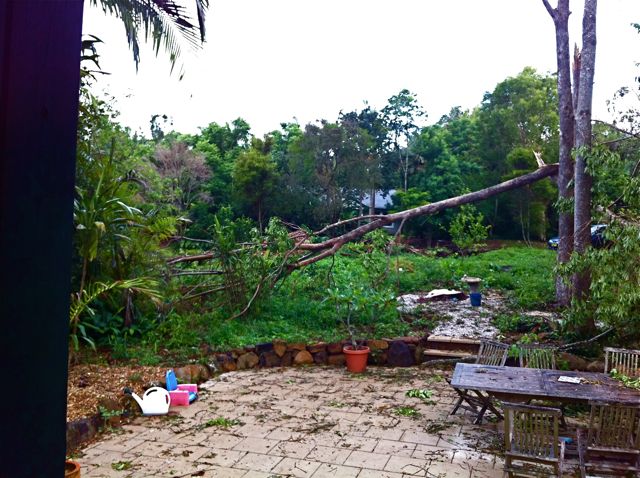
The end of our road after tropical cyclone Oswald - behind the fence is usually a paddock with cows in it.  This was three weeks ago.  Our local rivers have had 14 flood warnings since the start of 2013.

I was in Sydney when Oswald paid us a visit, but today we had another tremendous storm - one of the most ferocious I have ever experienced.  The winds have abated now but it is still raining.  I have just seen my son-in-law off, after having dinner here, with the three grandchildren wondering if they will get home OK - my daughter has gone to Melbourne with her girlfriends for the weekend ( they have bushfires down there with very dry hot winds!).  He already had to try three different ways to get here through flash floods and fallen trees across the roads.

Why risk it, you might ask? Well, once again they have no power at home - which means no water (they need a pump from the tank) and great difficulty getting dinner.  There are beds here if they can't get home, but they are also worried about their chickens and guinea pigs.
My daughter's place after the cyclone.  They lost a large Tallowood tree which left a drenched koala stranded on one branch - it eventually recovered and moved on - with another huge eucalypt down over their concrete water tank, fortunately not cracking it.  My husband tried to get up there to check on things, in vain as it turned out - water was over the road in several places -  he just ended up helping people clear fallen trees from the road and directing a carful of terrified Japanese tourists? (Less than perfect GPS again?)

This destructive weather causes so many problems for everyone around here.  The local community of Upper Repentance Creek, with about 40 families, are still isolated after four weeks because of a road slip - they have supplies flown in three times a week.

Many other families were without power or telephone for up to 10 days.  Imagine life for most people without their iPhones, television, refrigeration and internet connection for one day, let alone over a week?  As my friend Don says, who lives way up at Huonbrook and is one of the folk always affected by wild weather, it's good practice for the future.

You become resourceful - you have to; bucket showers, candlelit dinners, eating from the larder, lots of board games (I reckon the Byron Shire residents must be the Scrabble champions of the world by now) and community co-operation - we couldn't exist without it - I also think the maternity unit at the local hospital might also be very busy in nine months time?  My daughter, and her family, were away on holiday during the cyclone and couldn't get home because the highway was flooded.  Their neighbours rescued the guinea pigs and chickens, checked the house for any damage (thankfully none), saved their food out of the freezer and had chain-sawed up most of the fallen trees by the time they got home.

And on Friday, the day of the latest storm, we had another intense low pressure system off the coast with onshore wind gusts of up to 100km per hour with a massive dumping of rain - 127mm in 12 hours.  At midday it was falling at 720mm per hour - sheets and sheets of water.  I sat inside as the lights flickered watching my garden being lashed and shredded to pieces.  I woke up this morning to the sound of chain saws as folk begin the big mop up with trees down everywhere though, when I stepped out onto the lawn, water came up over the top of my boots - the ground is so sodden it is just not draining away.  It'll ruin the lawn if we start walking on it now.
I did venture down to Brunswick Beach for a walk and this is what I found - no beach!  The very high winds and mountainous seas had simply swept it away.
What it normally looks like!

My vegie garden is a disaster with bean plants uprooted and splattered against the chicken wire, eggplant and okra blown out of the ground and just about everything else wilted and waterlogged.  My datura, which was flowering beautifully, now looks like a tree of shredded hankies and a large frangipani in a pot was blown over, cracking the pot a making an amputated mess of the plant.  Fortunately, my son is an arborist and I have a huge pile of mulch out the front just waiting for it to dry up a bit - he dumped that there after the cyclone.  If you want some tips on fixing your soil after the rain - go to this link

I'm sure he will have lots more.  If you need any you can contact Nick Hart on 0427 347 380.

Storm rubbish on the beach - always disquieting is to see so much plastic, large, medium and minute pieces of plastic.  Friends and I went down after the cyclone and picked up bags and bags of plastic waste - straws, bottle tops, plastic bags, fishing tackle and lots and lots of polystyrene - the stuff that is causing a large area of the Pacific to become a toxic soup.  Looks like we will be busy again!

Interestingly, the little grey stony pieces always appear washed up on our east coast beaches after seismic activity in the Pacific - it's debris from a volcano - pummice.  The beach was recently strewn with this, and coconuts, after an earthquake and tsunami in the Solomon Islands.  Wild weather indeed.
"This island continent lies in the water hemisphere.  On the eastern coast, the neighbouring nation is Chile, though it is far, far east, Valparaiso being more than six thousand miles away in a straight line: her northern neighbours are those of the Timor Sea, The Yellow Sea; to the south is that cold, stormy sea full of earth-wide rollers, which stretches from there without land, south to the Pole".   For Love Alone, Christina Stead, 1945


Wednesday, February 20, 2013

Recipe: Coconut and Lime Syrup Cake

I love coconut in all it's forms - fresh coconut milk; succulent fresh white flesh; shredded and toasted on Balinese pancakes with lime and, of course, chocolate Bounty bars!.  A Swedish nutritionalist once told me that it was something to do with my blood type. This theory was confirmed for her by the fact that I also have blonde hair and I also love eggs and lemons/limes?.  (I hope this means that I can, without guilt, eat two or three pieces of this deliciously moist and tangy cake?)

But, in truth, it has now been raining for over a week, and I mean lashing rain - Mullumimby style, and I needed the smell of coconut cake cooking in the house rather than moulds growing!

I also had my first beautiful crop of limes from a tree I planted a couple of years ago. (I do find that citrus need a couple of years to settle in before they start bearing fruit).

I have been trying out variations on this recipe for a couple of years and this if by far the best.  The cake also came out evenly cooked with no cracks in it!! (Well, one small one)

Coconut and Lime Syrup Cake

Melted butter (optional), for greasing
250g unsalted butter, cubed, at room temperature
220g (1 cup) caster sugar
1 tsp vanilla essence
4 large eggs, at room temperature
250g (1 2/3 cups) plain flour
3 tsp baking powder
135g (1 1/2 cups) desiccated coconut
Extra coconut to serve

The family got to it before I could take a photo!.  Delicious with Greek yoghurt or cream
lime syrup
4 limes
165g (3/4 cup) caster sugar
185mls (3/4 cup) water

Step 1
Preheat oven to 170°C. Brush a 25cm springform pan with melted butter and line the bottom with non-stick baking paper.

Step 2
Beat butter in a medium bowl with an electric mixer or hand beaters on high until smooth. Add caster sugar and vanilla essence and beat, scraping down sides of bowl, until very pale (almost white) and creamy.

Step 3
Add the eggs, one at a time, beating well after each addition and scraping down the sides of the bowl frequently until light and well combined. Sift together the flour and baking powder. Gently fold the flour mixture and coconut into the butter mixture until combined.

Step 4
Spoon cake mixture into the cake pan and smooth surface. Bake in preheated oven for 50-55 minutes or until cooked through and a skewer inserted into the cake comes out clean.

Step 5
Meanwhile, to make lime syrup, peel rind from 2 limes with a vegetable peeler. Remove white pith from rind with a small, sharp knife (otherwise the syrup will be bitter) and then cut rind into very thin strips. Juice all 4 limes. Combine lime rind, 80mls (1/3 cup) of lime juice, sugar and water in a small saucepan and stir over medium heat until sugar dissolves. Bring to the boil and simmer, uncovered, over medium heat for 5 minutes. Remove from heat.

Step 6
When cake is cooked, remove from oven and stand in pan for 5 minutes before turning onto a wire rack. Place rack over a large plate or tray to catch any drips and pour hot syrup slowly and evenly over cake. Cool. Serve decorated with reserved lime rind strips and sprinkled with extra coconut, if desired.


Friday, February 8, 2013

Recipe: Baked Mushrooms with Ricotta

Sydney Harbour Bridge - trying to catch the setting sun

I've just been in Sydney for a couple of weeks - for a 'grease and oil change' and to see my little grandson who is now one.

I love walking around the city and hopping about on public transport (non-existent in our small country town - bring back the train that used to link Sydney with Brisbane and get the trucks off the road!!).  One of the benefits to getting older and being entitled to a Senior's Card, is being able to travel around all day on public transport for $2.50 - that's buses, trains and ferries - it's fantastic.


Street-scaping in Martin Place, Sydney CBD
Something that struck me this time, as I wandered around the city, is how much greener it is than it used to be - so much more 'street-scaping' with planter boxes, hanging baskets and fairly large 'green installations' - it just had the look of a more sophisticated place than it used to - more grown-up (the men were dressed far better than they used to be; stylish shoes, better cut suits, classier glasses and better haircuts - for a minute there I thought I was in Paris - or maybe it was because I was observing this waiting for a bus outside a French bank?!)

The hospital pig, Il Porcellino, a bronze copy of the famous Florentine statue

A visit to the Art Gallery of NSW is always on the cards.  It starts with an amble through Martin Place (the pedestrian centre of the CBD), a stroll along Macquarie Street (with the preserved sandstone heritage buildings of Parliament House, The State Library, The Mint and Barracks and through Sydney Hospital and out into the Domain Parklands that surround the Royal Botanic Gardens of Sydney.)  Just before you enter the hospital grounds don't forget to stroke the snout of the imposing bronze boar - said to bring good luck - I can't help giving him a pat every time I pass this way.


Art Gallery of NSW, Sydney
I

The Gallery is perched on the harbour with wonderful views from inside and outside this lovely golden sandstone building.  After the galleries of Europe, with their associated crowds, this is just such an accessible place to enjoy art.  Its' light filled rooms hold a fine collections of Asian, Australian, Impressionist and Aboriginal Art and I'm always finding something new - like this painting of the Tweed Valley where I live now.  It was painted nearly 100 years ago by Elioth Gruner and I suppose the stark thing that struck me, in both senses of the word, is that it shows such a desolate landscape - through indiscriminate burning and tree clearing -so different to the verdant lushness of today.  It gives me hope that there are maybe some things we are getting right.
Tweed Valley, northern NSW 2012
I was wandering around the gallery starving - waiting for a two hour session at the dentist to wear off.  Finally, I made my way to the lovely cafe, overlooking the Woolloomooloo Finger Wharf - where many migrants, arriving after a long sea voyage caught their first glimpse of Sydney, - to try and find something soft on the menu!

This dish was so simple in it's conception, and so absolutely delicious that I sought out the chef to find out the recipe.  It is very simple and no tricks to it at all.

Baked Mushrooms with Ricotta - this serves 2

2 large field mushrooms
250g ricotta
1 tbs finely chopped parsley or chives
A few fresh basil leaves, finely chopped
1 tbs freshly grated parmesan
salt and freshly ground black pepper
olive oil and balsamic vinegar to brush on the mushrooms

Turn oven on to 200o.  Remove stalks from mushrooms
TIP:  Never wash mushrooms - it ruins the texture - simply brush off any loose dirt.
Brush mushrooms with oil, balsamic vinegar and sprinkle with salt and pepper.
Place on a tray in the oven for 8 minutes.
Mix ricotta together with herbs, parmesan and salt and pepper.
Remove mushrooms from oven and pile ricotta mixture on top, bringing it to the edges.
Place back in the oven for a further 10 minutes until ricotta has golden tinges.


Serve with a wild rocket, pear and walnut salad with a balsamic dressing - the sweet, sharpness of the balsamic brings out the flavour of the mushrooms and ricotta.


I had to make it when I got back home as I had simply wolfed down the one at the Gallery before I thought about taking a photo - notice, I couldn't eat my crusts.
What better way to have your hunger sated - by visual beauty and baked mushrooms with ricotta?


Not everyone finds the Art Gallery as stimulating as I do!


Tuesday, February 5, 2013

Recipe: Hummingbird Cake with Passionfruit Frosting

"Six foot, seven foot, eight foot bunch!"  Lovely, creamy Cavendish bananas with two-thirds of this bunch already harvested.  

NOTE:  I'm not sure why this is called Hummingbird Cake as it definitely does not contain hummingbirds!

Whenever I make a cake for our Garden Club I always try to make it with something from the garden - a challenge sometimes.  Today was our first meeting of the year and we had an excursion to the Mullumbimby Community Garden.  Luckily I had some lovely ripe bananas, pineapple and passionfruit to make this tried and true Hummingbird Cake - a very easy recipe with very little preparation time - about 15 minutes.  Of course, everything you need to make this cake can also be bought from a shop.

NOTE: Pineapple is in the bromeliad family and make a wonderful border in the tropical garden.  They require very little care and attention and fruit after a couple of years or so.  To grow them you simply plant the green top off the fruit - it's that easy! 

You need:
HUMMINGBIRD CAKE 
1 cup plain flour (I use wholemeal)
1/2 cup self-raising flour
1/2 teaspoon bi-carb. soda
1/2 teaspoon cinnamon
1/2 teaspoon ginger
1 cup firmly packed brown sugar
1/2 cup desiccated coconut
2 eggs
3/4 cup vegetable oil (or extra light olive oil)
1 cup mashed banana 
450g can crushed pineapple in syrup, drained - or the equivalent fresh pulsed with the banana in a food processor


PASSIONFRUIT FROSTING:
100g cream cheese (I use Philadelphia brand because it is dense and doesn't make the icing sloppy)
100g softened butter
1 cup icing sugar mixture
1 tablespoon passionfruit pulp

Method:
Preheat oven to moderate....(I use 170C F/F gas oven).
Grease a deep, 19cm square (or round) cake tin and line base with baking paper. 
Sift flour, soda and spices into a large bowl and stir in sugar and coconut.
Combine lightly beaten eggs and vegetable oil and add to dry ingredients.
Then add mashed banana and drained pineapple.
When well combined, spread mixture into cake tin and bake in moderate oven for about 1 hour.
Let cake stand for a few minutes before turning out onto rack to cool.
When cold, top with the yummy passionfruit frosting and dust with desiccated coconut.


Volunteers day at the Mullumbimby Community Gardens - making lunch from some of their bountiful produce.
"As you sow, so shall you reap" 
Galatians VI