Sunday, February 24, 2013

February in Mullumbimby - The Big Wet

The end of our road after tropical cyclone Oswald - behind the fence is usually a paddock with cows in it.  This was three weeks ago.  Our local rivers have had 14 flood warnings since the start of 2013.

I was in Sydney when Oswald paid us a visit, but today we had another tremendous storm - one of the most ferocious I have ever experienced.  The winds have abated now but it is still raining.  I have just seen my son-in-law off, after having dinner here, with the three grandchildren wondering if they will get home OK - my daughter has gone to Melbourne with her girlfriends for the weekend ( they have bushfires down there with very dry hot winds!).  He already had to try three different ways to get here through flash floods and fallen trees across the roads.

Why risk it, you might ask? Well, once again they have no power at home - which means no water (they need a pump from the tank) and great difficulty getting dinner.  There are beds here if they can't get home, but they are also worried about their chickens and guinea pigs.
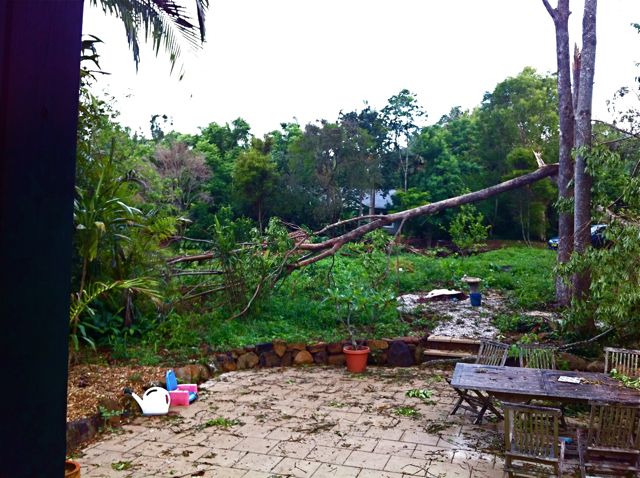
My daughter's place after the cyclone.  They lost a large Tallowood tree which left a drenched koala stranded on one branch - it eventually recovered and moved on - with another huge eucalypt down over their concrete water tank, fortunately not cracking it.  My husband tried to get up there to check on things, in vain as it turned out - water was over the road in several places -  he just ended up helping people clear fallen trees from the road and directing a carful of terrified Japanese tourists? (Less than perfect GPS again?)

This destructive weather causes so many problems for everyone around here.  The local community of Upper Repentance Creek, with about 40 families, are still isolated after four weeks because of a road slip - they have supplies flown in three times a week.

Many other families were without power or telephone for up to 10 days.  Imagine life for most people without their iPhones, television, refrigeration and internet connection for one day, let alone over a week?  As my friend Don says, who lives way up at Huonbrook and is one of the folk always affected by wild weather, it's good practice for the future.

You become resourceful - you have to; bucket showers, candlelit dinners, eating from the larder, lots of board games (I reckon the Byron Shire residents must be the Scrabble champions of the world by now) and community co-operation - we couldn't exist without it - I also think the maternity unit at the local hospital might also be very busy in nine months time?  My daughter, and her family, were away on holiday during the cyclone and couldn't get home because the highway was flooded.  Their neighbours rescued the guinea pigs and chickens, checked the house for any damage (thankfully none), saved their food out of the freezer and had chain-sawed up most of the fallen trees by the time they got home.

And on Friday, the day of the latest storm, we had another intense low pressure system off the coast with onshore wind gusts of up to 100km per hour with a massive dumping of rain - 127mm in 12 hours.  At midday it was falling at 720mm per hour - sheets and sheets of water.  I sat inside as the lights flickered watching my garden being lashed and shredded to pieces.  I woke up this morning to the sound of chain saws as folk begin the big mop up with trees down everywhere though, when I stepped out onto the lawn, water came up over the top of my boots - the ground is so sodden it is just not draining away.  It'll ruin the lawn if we start walking on it now.
I did venture down to Brunswick Beach for a walk and this is what I found - no beach!  The very high winds and mountainous seas had simply swept it away.
What it normally looks like!

My vegie garden is a disaster with bean plants uprooted and splattered against the chicken wire, eggplant and okra blown out of the ground and just about everything else wilted and waterlogged.  My datura, which was flowering beautifully, now looks like a tree of shredded hankies and a large frangipani in a pot was blown over, cracking the pot a making an amputated mess of the plant.  Fortunately, my son is an arborist and I have a huge pile of mulch out the front just waiting for it to dry up a bit - he dumped that there after the cyclone.  If you want some tips on fixing your soil after the rain - go to this link

I'm sure he will have lots more.  If you need any you can contact Nick Hart on 0427 347 380.

Storm rubbish on the beach - always disquieting is to see so much plastic, large, medium and minute pieces of plastic.  Friends and I went down after the cyclone and picked up bags and bags of plastic waste - straws, bottle tops, plastic bags, fishing tackle and lots and lots of polystyrene - the stuff that is causing a large area of the Pacific to become a toxic soup.  Looks like we will be busy again!

Interestingly, the little grey stony pieces always appear washed up on our east coast beaches after seismic activity in the Pacific - it's debris from a volcano - pummice.  The beach was recently strewn with this, and coconuts, after an earthquake and tsunami in the Solomon Islands.  Wild weather indeed.
"This island continent lies in the water hemisphere.  On the eastern coast, the neighbouring nation is Chile, though it is far, far east, Valparaiso being more than six thousand miles away in a straight line: her northern neighbours are those of the Timor Sea, The Yellow Sea; to the south is that cold, stormy sea full of earth-wide rollers, which stretches from there without land, south to the Pole".   For Love Alone, Christina Stead, 1945


Wednesday, February 20, 2013

Recipe: Coconut and Lime Syrup Cake

I love coconut in all it's forms - fresh coconut milk; succulent fresh white flesh; shredded and toasted on Balinese pancakes with lime and, of course, chocolate Bounty bars!.  A Swedish nutritionalist once told me that it was something to do with my blood type. This theory was confirmed for her by the fact that I also have blonde hair and I also love eggs and lemons/limes?.  (I hope this means that I can, without guilt, eat two or three pieces of this deliciously moist and tangy cake?)

But, in truth, it has now been raining for over a week, and I mean lashing rain - Mullumimby style, and I needed the smell of coconut cake cooking in the house rather than moulds growing!

I also had my first beautiful crop of limes from a tree I planted a couple of years ago. (I do find that citrus need a couple of years to settle in before they start bearing fruit).

I have been trying out variations on this recipe for a couple of years and this if by far the best.  The cake also came out evenly cooked with no cracks in it!! (Well, one small one)

Coconut and Lime Syrup Cake

Melted butter (optional), for greasing
250g unsalted butter, cubed, at room temperature
220g (1 cup) caster sugar
1 tsp vanilla essence
4 large eggs, at room temperature
250g (1 2/3 cups) plain flour
3 tsp baking powder
135g (1 1/2 cups) desiccated coconut
Extra coconut to serve

The family got to it before I could take a photo!.  Delicious with Greek yoghurt or cream
lime syrup
4 limes
165g (3/4 cup) caster sugar
185mls (3/4 cup) water

Step 1
Preheat oven to 170°C. Brush a 25cm springform pan with melted butter and line the bottom with non-stick baking paper.

Step 2
Beat butter in a medium bowl with an electric mixer or hand beaters on high until smooth. Add caster sugar and vanilla essence and beat, scraping down sides of bowl, until very pale (almost white) and creamy.

Step 3
Add the eggs, one at a time, beating well after each addition and scraping down the sides of the bowl frequently until light and well combined. Sift together the flour and baking powder. Gently fold the flour mixture and coconut into the butter mixture until combined.

Step 4
Spoon cake mixture into the cake pan and smooth surface. Bake in preheated oven for 50-55 minutes or until cooked through and a skewer inserted into the cake comes out clean.

Step 5
Meanwhile, to make lime syrup, peel rind from 2 limes with a vegetable peeler. Remove white pith from rind with a small, sharp knife (otherwise the syrup will be bitter) and then cut rind into very thin strips. Juice all 4 limes. Combine lime rind, 80mls (1/3 cup) of lime juice, sugar and water in a small saucepan and stir over medium heat until sugar dissolves. Bring to the boil and simmer, uncovered, over medium heat for 5 minutes. Remove from heat.

Step 6
When cake is cooked, remove from oven and stand in pan for 5 minutes before turning onto a wire rack. Place rack over a large plate or tray to catch any drips and pour hot syrup slowly and evenly over cake. Cool. Serve decorated with reserved lime rind strips and sprinkled with extra coconut, if desired.


Friday, February 8, 2013

Recipe: Baked Mushrooms with Ricotta

Sydney Harbour Bridge - trying to catch the setting sun

I've just been in Sydney for a couple of weeks - for a 'grease and oil change' and to see my little grandson who is now one.

I love walking around the city and hopping about on public transport (non-existent in our small country town - bring back the train that used to link Sydney with Brisbane and get the trucks off the road!!).  One of the benefits to getting older and being entitled to a Senior's Card, is being able to travel around all day on public transport for $2.50 - that's buses, trains and ferries - it's fantastic.


Street-scaping in Martin Place, Sydney CBD
Something that struck me this time, as I wandered around the city, is how much greener it is than it used to be - so much more 'street-scaping' with planter boxes, hanging baskets and fairly large 'green installations' - it just had the look of a more sophisticated place than it used to - more grown-up (the men were dressed far better than they used to be; stylish shoes, better cut suits, classier glasses and better haircuts - for a minute there I thought I was in Paris - or maybe it was because I was observing this waiting for a bus outside a French bank?!)

The hospital pig, Il Porcellino, a bronze copy of the famous Florentine statue

A visit to the Art Gallery of NSW is always on the cards.  It starts with an amble through Martin Place (the pedestrian centre of the CBD), a stroll along Macquarie Street (with the preserved sandstone heritage buildings of Parliament House, The State Library, The Mint and Barracks and through Sydney Hospital and out into the Domain Parklands that surround the Royal Botanic Gardens of Sydney.)  Just before you enter the hospital grounds don't forget to stroke the snout of the imposing bronze boar - said to bring good luck - I can't help giving him a pat every time I pass this way.


Art Gallery of NSW, Sydney
I

The Gallery is perched on the harbour with wonderful views from inside and outside this lovely golden sandstone building.  After the galleries of Europe, with their associated crowds, this is just such an accessible place to enjoy art.  Its' light filled rooms hold a fine collections of Asian, Australian, Impressionist and Aboriginal Art and I'm always finding something new - like this painting of the Tweed Valley where I live now.  It was painted nearly 100 years ago by Elioth Gruner and I suppose the stark thing that struck me, in both senses of the word, is that it shows such a desolate landscape - through indiscriminate burning and tree clearing -so different to the verdant lushness of today.  It gives me hope that there are maybe some things we are getting right.
Tweed Valley, northern NSW 2012
I was wandering around the gallery starving - waiting for a two hour session at the dentist to wear off.  Finally, I made my way to the lovely cafe, overlooking the Woolloomooloo Finger Wharf - where many migrants, arriving after a long sea voyage caught their first glimpse of Sydney, - to try and find something soft on the menu!

This dish was so simple in it's conception, and so absolutely delicious that I sought out the chef to find out the recipe.  It is very simple and no tricks to it at all.

Baked Mushrooms with Ricotta - this serves 2

2 large field mushrooms
250g ricotta
1 tbs finely chopped parsley or chives
A few fresh basil leaves, finely chopped
1 tbs freshly grated parmesan
salt and freshly ground black pepper
olive oil and balsamic vinegar to brush on the mushrooms

Turn oven on to 200o.  Remove stalks from mushrooms
TIP:  Never wash mushrooms - it ruins the texture - simply brush off any loose dirt.
Brush mushrooms with oil, balsamic vinegar and sprinkle with salt and pepper.
Place on a tray in the oven for 8 minutes.
Mix ricotta together with herbs, parmesan and salt and pepper.
Remove mushrooms from oven and pile ricotta mixture on top, bringing it to the edges.
Place back in the oven for a further 10 minutes until ricotta has golden tinges.


Serve with a wild rocket, pear and walnut salad with a balsamic dressing - the sweet, sharpness of the balsamic brings out the flavour of the mushrooms and ricotta.


I had to make it when I got back home as I had simply wolfed down the one at the Gallery before I thought about taking a photo - notice, I couldn't eat my crusts.
What better way to have your hunger sated - by visual beauty and baked mushrooms with ricotta?


Not everyone finds the Art Gallery as stimulating as I do!


Tuesday, February 5, 2013

Recipe: Hummingbird Cake with Passionfruit Frosting

"Six foot, seven foot, eight foot bunch!"  Lovely, creamy Cavendish bananas with two-thirds of this bunch already harvested.  

NOTE:  I'm not sure why this is called Hummingbird Cake as it definitely does not contain hummingbirds!

Whenever I make a cake for our Garden Club I always try to make it with something from the garden - a challenge sometimes.  Today was our first meeting of the year and we had an excursion to the Mullumbimby Community Garden.  Luckily I had some lovely ripe bananas, pineapple and passionfruit to make this tried and true Hummingbird Cake - a very easy recipe with very little preparation time - about 15 minutes.  Of course, everything you need to make this cake can also be bought from a shop.

NOTE: Pineapple is in the bromeliad family and make a wonderful border in the tropical garden.  They require very little care and attention and fruit after a couple of years or so.  To grow them you simply plant the green top off the fruit - it's that easy! 

You need:
HUMMINGBIRD CAKE 
1 cup plain flour (I use wholemeal)
1/2 cup self-raising flour
1/2 teaspoon bi-carb. soda
1/2 teaspoon cinnamon
1/2 teaspoon ginger
1 cup firmly packed brown sugar
1/2 cup desiccated coconut
2 eggs
3/4 cup vegetable oil (or extra light olive oil)
1 cup mashed banana 
450g can crushed pineapple in syrup, drained - or the equivalent fresh pulsed with the banana in a food processor


PASSIONFRUIT FROSTING:
100g cream cheese (I use Philadelphia brand because it is dense and doesn't make the icing sloppy)
100g softened butter
1 cup icing sugar mixture
1 tablespoon passionfruit pulp

Method:
Preheat oven to moderate....(I use 170C F/F gas oven).
Grease a deep, 19cm square (or round) cake tin and line base with baking paper. 
Sift flour, soda and spices into a large bowl and stir in sugar and coconut.
Combine lightly beaten eggs and vegetable oil and add to dry ingredients.
Then add mashed banana and drained pineapple.
When well combined, spread mixture into cake tin and bake in moderate oven for about 1 hour.
Let cake stand for a few minutes before turning out onto rack to cool.
When cold, top with the yummy passionfruit frosting and dust with desiccated coconut.


Volunteers day at the Mullumbimby Community Gardens - making lunch from some of their bountiful produce.
"As you sow, so shall you reap" 
Galatians VI


Monday, January 14, 2013

Trees: Solving Common Problems

A beautiful old native fig tree - showing evidence of getting a bit thin on top!

How many hats do you have?  On Saturday I had to put on one of the many I seem to juggle - this one was Di the arborist ( I also needed my thinking cap!).  Now, it's been a long time since I climbed a tree with a chainsaw hanging from my belt, but I can still tell a healthy tree from one under stress.  This one was definitely under stress.

Lisa and Marcus had called me up about their fig tree - we are talking about an over one hundred years old Moreton Bay Fig (Ficus macrophylla), a significant tree and one that they really love.  It is the focal point of their property, providing shade, branches to swing from and a sedate backdrop from the house.   Why did they call me - because it was dramatically shedding it's leaves i.e. the crown was thinning.

So what are they key things I look for when a tree is beginning to lose it's vigour?  This bit of detective work will help you solve the problem.  Here is a checklist that you can follow and WHAT TO DO TO REMEDY THE PROBLEM.

1.  How does the canopy look? This one was thinning - losing it's leaves.  Sudden decline, or death of a tree, is almost always a root problem - so think about what is going on there first.  Remember - the answer lies in the soil!

2.  How does the trunk look - any signs of splitting, cracking or insect attack (borers leave tell-tale holes , webbing and  sawdust). None of the above.  Splitting is usually a sign of excessive over or under watering (sometimes, but rarely, a lightening strike).

3.  Any recent disturbance to the roots or soil above the roots.  Yes, this had landscaping machinery running over it recently causing compaction.  Roots thrive on air and water.  If they are cut-off, disturbed, poisoned, compacted - THE TREE WILL NOT THRIVE.
Soil compaction all around the drip-line of the tree caused by heavy machinery

(It's amazing how many times I have been called out to a tree that is suddenly looking sick, only to find that the owners have; chopped through half the roots to build footings for a new building or swimming pool, had painters and builders in who have dumped their waste under the nearest tree, laid a new driveway or built a paved patio over the roots etc.etc.)
WHAT TO DO: The best way to remedy soil compaction problems is to aerate it.  Now you can do this by having a big garden party and asking everyone to wear high heels OR you can hire an aerator - a kind of roller with spikes on it.  NEXT you top-dress the area with a free-draining soil mix.  Most landscape suppliers will have a bulk top-dressing mix specifically for this purpose.

4.  Any signs of disease or insect attack to the leaves.  Yes, this had a common leaf sap sucker of figs - psyllid.
Evidence of sap-sucking fig psyllid
There are many different kinds of fig trees, and most of us are probably familiar with the delicious fruit from the edible fig-tree or the latex extracted from the tropical variety that goes to make rubber.  In our area we have nine figs that thrive in the rainforests - this is one of them - and they all have a tacky white sap.  Hence the sticky stuff left by this sap sucker as it munches into the leaf. It sticks to your shoes like chewing gum.  Under natural conditions psyllids are kept under control by birds and other insects that live in the leaf litter that accumulates under the tree.
WHAT TO DO: Think how the tree grows in it's natural environment and try to replicate it. 1.  Do not have grass growing right up to the trunk of trees - grass is thirsty - it competes with the tree for water and nutrients.  2.  Mulch under trees.  I saw this as a simple solution to solving a fig psyllid problem, some years ago, when I worked at the Royal Botanic Gardens in Sydney. Mulch also provides the right environment for natural predators of the psyllid. (Mulch had been put under part of the tree a year or so ago, but it needed to extend out further from the trunk and be replenished.

5.  Any environmental reasons for the tree to be under stress.  Yes, we have had a long, dry winter.
WHAT TO DO:  We are coming into out wet season so watering probably won't be necessary.  If, however, you have a long, dry period - make sure your large trees are mulched (this help to retain moisture) and that they are adequately watered.

6.  Check the pH levels of the soil around the tree.  This was about 7.5 - a little alkaline for a tree like this - probably due to recent building works and run-off from them.  In my experience, most soils around houses prove to be on the alkaline side - lime/alkaline products are a large component of concrete, mortar and other construction materials.
WHAT TO DO:  To correct the pH and give the tree a boost it would help to feed it.  Correcting any nutrient imbalance will also help to make it more resistant to pest and disease attack  Most of the feeder roots of the tree are around the drip-line so this is where you fertilize a tree. Going in a rough circle under the drip-line - dig holes, roughly the size a tennis ball canister, 1-2 m apart (depending on the size of the tree) and pack them full of an organic fertilizer.  Like this, they act as a slow-release fertilizer and keep feeding the tree over a long period of time.

Click on this link for CARE OF CITRUS TREES

Sunday, January 6, 2013

Recipe: Mango Chutney

Thoughtful friends who know exactly what to give me for Christmas - a big bag of cow poo!


A hopeful, healthy and Happy New Year to the amazing 35,000 people who read this blog in 2012.  All I aspire is to is to give your heart some hope, your taste buds extra zing and more power to your green thumb!

I have been feeling sad - hence the quietness.  I lost my Dad in November - it's hard to lose people you love and you know who truly loved you.  Then, just when I returned to Australia, my dear friend lost her 19 year old son in a tragic car accident. A time for reflection.

However, it's hard to be sad with six grandchildren around.  There has been very little gardening done over the festive season, but lots of cooking, cooking, cooking!  Finally, they have all gone home and I can think about the coming year.  I am aiming for a little more 'me' time in 2013.  We'll see.

Mango tree with fruit about to ripen
One of the benefits of a long, dry winter has been the amazing display of all the tropical flowering trees - and this includes the mango.  It flowers around October and we hope for no big storms then as they knock the flowers off - and this means no fruit.  Not this year.  Shortly we will all be woken up to the sounds of mangos dropping on tin roofs - it sounds like a thunderclap.  These gorgeous trees are just laden with ripening fruit - happy days.

This is a recipe I have been making for many years to give as Christmas gifts.  When I lived in Sydney my dear friend, Sheila and I, would toil happily over a big bubbling pot of mango chutney.  Peeling and dicing mangoes is a messy business and it's always better shared over a cup of tea and a chat.  This works best when the mangoes are slightly green and you end up with some some residual chunks - instead of a kind of jam (which still tastes good!)


Mango Chutney
So, since it is very easy to make, here is a recipe which includes large luscious chunks of mango. It is really good served with cold ham, poultry or game – or, of course, any kind of curry.

This is, honestly, the best mango chutney I have ever tasted!  I have been tweeking it for about twenty years to perfect the consistency and flavour.

2.5 kilos of slightly under-ripe mangoes

700g soft light brown sugar

1 level teaspoon cumin seeds

2 heaped teaspoons coriander seeds

12 cardamom pods, bruised in a mortar and pestle to expose the seed

1 level teaspoon ground red chilli

1 level teaspoon ground turmeric

110g fresh root ginger, peeled and grated

1 level teaspoon ground cloves

350 ml malt vinegar

8 cloves garlic, peeled and crushed

2 heaped teaspoons sea salt

2 brown onions, peeled and finely chopped.

To sterilise jars, they should be washed, dried and heated in a moderate oven for 5 minutes.
You will also need a preserving pan or large wide saucepan.

My Mango Chutney
Begin this recipe a day ahead by preparing the mangoes. The easiest way to do this is to cut the two cheeks away from the stone with the skin on.  Segment the flesh of each cheek with a paring knife in a criss-cross fashion into bite size pieces.  Scoop out the flesh with a spoon.

Peel the skin off the remaining flesh on the stone and slice off the flesh.

Then sprinkle the sugar over the fruit in the bowl, turning it lightly to distribute the sugar evenly, cover and leave it in a cool place overnight (or a couple of hours if you are in a hurry)

This chutney really works best if the cumin, cloves and coriander  are freshly ground.  I have bought an electric spice grinder just for this purpose and the difference really is in the taste!  It explodes in your mouth.

Add the freshly ground spices, leaving the cardamom whole but slightly bruised, and add all the other ingredients.

Heat it until it begins to bubble and let it simmer for about 2 hours, stirring from time to time, until the mango becomes translucent and the liquid has almost evaporated, leaving behind a thick syrup.

You will need to do a bit more stirring from time to time at the end to prevent it catching.

After that remove the chutney from the heat, let it cool for 15 minutes then ladle it into warm sterilized jars. Seal whilst the chutney is still hot and label when cold. Best if left to mature for a few weeks, but you can eat it straight away.

Wednesday, December 19, 2012

Frederick Chamberlain 21 April 1922-11 Nov 2012

Somewhere in North Africa - about 1941 - aged 19

My father died last month - that is why the blog has been quiet for a while.  I had a phone call at 9 am one Sunday morning (the phone call I have been dreading for forty years)to say that he had been taken to hospital and was seriously ill.   Four hours later he was dead. And so the mad and hasty flight from hot and steamy Australia to my cold and snowy birthplace began. A life is a big thing and I make an attempt here to sum up his ninety eventful years:  Fred, soldier - Gunner Chamberlain 904741, Police Constable 700E, Freddie, Dad, Pops and Supergramps - the father I loved very much.

My Dad succeeded where so many other men fail – he was faithful, kind, loyal, generous, resourceful, ever cheerful and a very loving son, brother, husband, father to three, grandfather to six and great-grandfather to seven – the youngest bearing his name.

He was the youngest child of seven, and only son, born into a first generation East London family that had previously lived for generations in rural Cambridgeshire around Royston.  His father Walter, however, was given opportunities not afforded previous generations and became a civil engineer with Mowlem's construction company. My father spoke fondly of visiting his fathers’ workshop and office under Blackfriars Bridge – a project that Walter had worked on as foreman engineer. (Walter died just before Mum and Dad got married but Gertie, his mother, lived to 90)  He was deeply fond of his mother Gertrude, or ‘Ike’ as he called her (I don't know why), who came to live with us for seven years during the 1950’s - she having lost her house in Hackney in a wartime bombing raid.

(Dad’s grandfather, Moses Chamberlain was, interestingly, at the forefront of the beginning of the industrial fertilizer industry in the 1850's – he was a Coprolite Digger – a digger up of dinosaur bones and pooh.  A long seam of these remains emerged across the countryside of Cambridgeshire and Suffolk with the processing centre in Royston.  The Chamberlain family suddenly found their economic situation remarkably improved and moved to north London where Walter was able to get a better education and professional training.  I find this a remarkable bit of family history.  Is it in the genes? All I have done for my whole working life as a gardener is collect pooh – horse, chicken, cow – dinosaur would have been much more fun - and bang on about it’s benefits to anyone who has ever been interested?).


Dad about 1944

At 16, in 1938, Fred joined the Territorial Army and then, after being called up in 1939, spent the war years, and his early adulthood, as a gunner in the 8th Army under Montgomery with the next six years in North Africa as a ‘Desert Rat’ then Palestine and finally Italy – which always held a special place in his heart – learning to speak the language, how to cook, ski, play the mouth organ, appreciate the fairer sex and sing – something, which till his dying day never left him.  Interestingly he said that most of the songs in his Italian repertoire were taught to him by the famous tenor Beniamino Gigli.  He spent several years with the British Army in Italy and, at one point, he and his troops were given the job of driving him to safety from enemy territory and as Gigli didn’t want to sit up the back of the truck with the smoking troops he sat up the front with Fred, the driver.  He joined the army as a boy and left as a man.  It’s somehow fitting that he died on Remembrance Day.

(Dad used to amuse his grandchildren with his stories from the war.  One, in particular, was that it was so hot in the desert that ‘Monty’ used to send him to the North Pole to get ice for his gin and tonic – by the time he got back it had melted so he would make him turn around and go all the way back again to fetch some more).

Wedding Day in Leytonstone 1947

While he was on demob leave in 1945 he met my mum, Barbara from Birmingham (then 18 years old), who was working behind the bar in her Mum and Dad’s pub in Leytonstone, London and the rest, they say, is history – spending the next 65 years very happily married and bringing up their three children Stephen, Diane and Paul.  They have been true soul-mates, dancing their way through all the trials and tribulations that life throws at you.

(During recent years Dad slowly left us for the twilight zone of dementia with my Mum lovingly caring for him at home, eventually even receded from her.  He would, however have moments of lucidity.  When I was there in July, Mum had a faded rose in a vase and she told me that Dad had unusually ventured out into the garden, picked the rose and given it to my Mum with a kiss and said “for you my love”).

In 1947 Fred joined the City of London Police Force and spent the next 30 years as a respected police officer with skill as a squad car driver, expert marksman and cribbage player – and, of course enough colourful stories to fill many volumes. His career coincided, in many ways with that of the young Queen Elizabeth, being on duty for the funeral of her father and her Coronation in 1953 – in fact, he shared her birthday 21 April.  He also served as Police Guard for many Royal Banquets for visiting heads of state at the Guildhall and was on duty at the state funeral for Winston Churchill.  He was also one of the first Police Officers on the scene at many of the IRA bombings in London during the 1970’s where some of his fellow officers were injured. For many years the Old Bailey seemed to be his second home.

Dad in a recruitment photo for the City of London Police

The war years had given Fred a serious case of wanderlust and from the late 1950’s he took his young family for the summer holidays on memorable camping trips to Europe where the first stop was always the local wine co-operative.  Holidays and travel were an imperative part of the Chamberlain families’ lives with many adventurous trips and albums of happy memories. (Sitting around camping sites in Spain with dad playing "Lilly Marlene" on the mouth-organ, after he had cooked up his famous bolognese made from canned corned beef, glass in hand and mischievous smile - the family camped next to us were German!)


Me (about 5) my brother Stephen and Mum and Dad on one of our motorbike and sidecar adventures.

The wanderlust continued.  As soon as Fred retired from the police force he and Barbara took off in their camper van on what was to be a round the world trip that would last for over four years.  They travelled overland through Western Europe and then through the Middle East from Iran to Afghanistan, the Khyber Pass, Pakistan and for an extended stay in India (where the family received startling photos of them semi-naked on the beaches of Goa!)  This amazing journey then took them on to Malaysia, Singapore and finally shipping the van to Australia to visit me and my young family in Sydney, having migrated there in 1975 – with Australia quickly becoming their second home visiting many times, with the last trip just five years ago.


Their last trip to Australia in 2007

After 2 years there, New Zealand, Fiji and the Americans beckoned where they spent another happy year working, travelling, visiting family (two of Dad's nieces were GI brides) and making more lifelong friends.

For the last 24 years Fred and Barbara have lived in Wrabness, north Essex – taking the life of their rural village to their hearts.  Fred has always been a gardener –  first with an allotment in Brockley, London and this life-long love continued with their garden in Wrabness with my mum by his side growing vegetables, fruit  and wonderful flower displays – and enough produce to have a roadside stall.  Fred always kept busy with art classes, a stint as Public Footpath Warden and the village hall committee, dancing club, playing bowls (collecting a shelf of trophies) and many rounds of fundraising, working bees and fun nights in various fancy dress outfits taking the dance floor with Barbara.  It was only ill health in the past few years that eventually slowed him down and it was only when his breath was finally gone that he stopped singing.

(I thought, when I was growing up, that all men were like my father – couldn’t they all sing and speak Italian, cook, shop, lovingly care for babies and children, have the amazing ability to turn the other cheek and be ever cheerful and constantly cracking jokes?.  One of my brother’s friends recently told me that he decided to join the Police Force because he said my Dad was always laughing and so cheerful and thought that it couldn’t be such a bad job if Dad was such a happy man.

Even though distance has kept us apart for a long time he is always with me - his voice in my ear when I’m not doing a job well enough – he was a perfectionist after all. I don’t think anyone, ever again, will call me a daft ha’p’orth or tell me that they fancy some cough and sneeze?
He taught me how to be a human being - I would be happy to be half the person he was - and I am so very glad that he was my father). 

Organizing your father's funeral is a very surreal business.  I comforted myself by spending time in his shed.  Don't tell Australian customs, but I smuggled in his hand-made dibbling stick - at least 40 years old (wooden items with soil on them are a definite no-no if you are planning to come here). It's comfortingly on my desk while I write this.  At his funeral, his police colleagues formed a a guard of honour in the biting cold with the City of London flag draped over his coffin.  At the end of the ceremony he had wanted Vera Lynn singing 'We'll meet again' and everyone, fittingly, linked arms and sang along. 'We'll meet agin, don't know where, don't know when, but I know we'll meet again some sunny day....................'


The Lake Isle of Innisfree

I WILL arise and go now, and go to Innisfree,
And a small cabin build there, of clay and wattles made;
Nine bean rows will I have there, a hive for the honey bee,
And live alone in the bee-loud glade.
And I shall have some peace there, for peace comes dropping slow,
Dropping from the veils of the morning to where the cricket sings;
There midnight's all a glimmer, and noon a purple glow,
And evening full of the linnet's wings.
I will arise and go now, for always night and day
I hear lake water lapping with low sounds by the shore;
While I stand on the roadway, or on the pavements gray,
I hear it in the deep heart's core.
William Butler Yeats. 


Sunday, November 25, 2012

Recipe: Hummus

Making your own hummus is very quick and very easy - and what's more it's very good for you.

Hummus is high in iron and vitamin C and also has significant amounts of folate and vitamin B6. The chickpeas are a good source of protein and dietary fibre; the tahini consists mostly of sesame seeds, which are an excellent source of the amino acid methionine, complementing the proteins in the chickpeas - and the sesame is where the high source of iron comes from.

It's a great vegetarian food and like other combinations of grains and pulses, it serves as a complete protein when eaten with bread.

No meal in the Middle East would be complete without a freshly made plate of hummus and passions run high over it's origin and 'the authentic recipe'.  In fact, the 'hummus wars' have been going on for some time between Lebanon (who want to patent the recipe) and Israel (who exports the largest quantities around the world).

This is the recipe I have tweeked over the years to be to my taste and I make it at least once a week - it's the ideal thing to give hungry children after school.

1 400g can of organic chick peas.
Juice of 1 small lemon
2 tbs tahini (sesame seed paste)
1 small clove of crushed garlic
1 small tsp ground cumin
sea salt to taste
2 tbs extra virgin olive oil (approximate)

Strain the chick peas of all their canned liquid.
Put all ingredients in a food processor and pulse until a smooth consistency.
If, at this stage, the hummus is very thick you may want to add a small amount of water to thin it.

Serve on a plate with the hummus fluffed up around the edge.  Drizzle with olive oil and paprika or finely chopped parsley or mint.  This is making me hungry!

Graffiti from a wall in inner Sydney in the late 70's.
"God hates homos". Written underneath - "But does he like tabouli? 
I can never eat hummus without thinking of this and smiling


Saturday, November 10, 2012

Mullumbimby Food and Soil Festival 2012

Repeating the great success of last year, we had another fantastic Food Festival in the Mullumbimby Community Gardens - with a focus this year on SOIL, why and how we should treasure and respect it.

There were all sorts of workshops, with everything from Biodynamics to "What Weeds Tell Us", to making a No-Dig bed to a "Bug Trail" and lots more in between.  In just four short years (I bet it feels very long to the extremely passionate and hardworking organizing committee) they have transformed an old paddock into the thriving heart and soul of Mullumbimby.

My grandchildren particularly enjoyed the lunchtime 'Fork in the Field' where they went on a grazing walk through the garden - picked their lunch, cooked it then ate it - then went home with a lovely palm basket they made in a workshop.

I had fun walking round the garden all day with a big silly hat on which said "Ask me a Gardening Question"?  (Of course Murphy's Law says I wouldn't know the first one I was asked and that, of course, was correct!)
Illawarra Flame Tree Brachychiton acerifolium in all it's glory.  The lack of rain in recent months puts  trees under stress which prompts them to put on a more spectacular flowering display.

It certainly is Festival time around Mullum at the moment.  As I write I can hear the loud-hailer from the showground, behind me in the valley, with the Mullum Country Show in progress - with livestock judging, horse jumping and lots of chooks and more folk in big hats.

Just a couple of weeks ago we had the Sample Food Festival in Bangalow - which showcases all the fabulous artisan food makers, chefs and restaurants on the North Coast - and next weekend is the Mullumbimby Music Festival.
'Salumi' local cured meat, sausage and ham makers from Billinudgel at the Sample Food Festival

Golden Penda Xanthostemon chrysanthus.  Another spectacular Australian tree flowering now and namesake of the the street I live in - although a lot of people get it wrong and I get letters addressed to Golden Panda Place! ( It's funny how developers chop down all the trees and then name the streets after them.)

It also serves as a timely reminder that in times of water shortage native plants are going to fare better than many exotics.

These little folk in a different kind of big hat have cropped up around here recently too!  Congratulations to all of my readers in the US who elected Barack Obama for a second term - hope continues!.  86% of Australians wanted him to win too!


Monday, November 5, 2012

Recipe: Any Fruit Tea Cake

This is one of those fabulous recipes that is so versatile - I make it all the time if I have unexpected guests for afternoon tea.  This one is with apple, rhubarb and raspberries.

It's really a chorus of the previous post for 'garden quiche' - "A recipe is a tune that you can sing your own song to".  I make this with any fruit that I have to hand - at the moment that is mulberries, peaches, nectarines, raspberries and rhubarb (lots of rhubarb!).  But, it can be apples, pears, apricots, figs, strawberries, plums, cherries, purple grapes, blueberries - in fact, just about anything.

Preheat oven to 160oC.  Grease a 22 cm round spring-form cake tine.

125g butter at room temperature
1 cup caster sugar
1 tsp vanilla extract
2 eggs
11/2 cups wholemeal, self-raising flour (you can use plain)
1 tsp ground cinnamon
1/2 tsp baking powder
3 tbsp icing sugar, sifted
1 1/2 cups seasonal fruit (see above)

1.  In food processor, beat butter, sugar and vanilla essence until pale and creamy.
2.  Add the eggs, one at a time, until fluffy
3.  Gently fold in flour, cinnamon and baking powder (you can do this with the 'pulse' button)
4.  Spoon mixture into prepared tin and scatter chopped fruit over the top.
5.  Dust the top with half the icing sugar (this makes it crunchy) and bake in oven for 50-60 mins.
6.  Remove from oven when cooked.  Dust with remaining icing sugar.
This cake is best eaten within a couple of days.

Unexpected and hungry guests for afternoon tea!!


Wednesday, October 24, 2012

Garden Quiche

Fresh salmon quiche with dill and spring onions (or chives/baby leeks).  You need about 300 g of skinned, cubed fresh salmon.  For a quiche this large (30 cm) you need 9 eggs instead of 6.

This dish is all about the food I try to cook - what do I have in the garden and larder to make dinner with? Or, to put it another way - how- for the smallest amount of money, and littlest of effort, make something delicious and nutritious that will feed a lot of people? (See quote at bottom of page)

THE PASTRY:  If you have a food processor you can make up quantities of this pastry to keep in the freezer.  I use a simple recipe that I previously posted for Sorrel Tart.  This is double that recipe. Half for now and half for later.
300 g chilled unsalted butter
400 g plain flour (half/half wholemeal and white)
3 tbs full cream Greek yoghurt
1 small tsp sea salt.

NOTE:  Don't be afraid of making pastry - it's so versatile and so much better than the frozen supermarket stuff.  You can use this pastry recipe for sweet or savoury dishes.  All you need is a food processor!

Whaz the butter and flour together then add the yoghurt and pulse until it forms one clump. Divide in half for two pastry cases - store one half in the freezer for another time.

Let the other half rest in the fridge (covering first in cling film) for about 20 mins - it then become rollable - important if the weather is slightly warm, otherwise it will just fall apart.

TOP TIP:  Put it in the fridge in a round flat shape with smooth edges - ready to toll out.  If you just bung it in lump it is much harder to roll out later. I learned the hard way!

Baking blind!
Roll out and line a fluted quiche dish.  You now have to bake it blind - cooking the pastry case without it rising.  If you don't do this and put the eggy filling in straight away - the pastry at the bottom will be soggy - and we don't want that!

Line the pastry with non-stick baking paper and weigh down with pasta or beans - you can re-use this.

TOP TIPS: Don't use foil, it sticks to the pastry.  Have enough baking paper to make 'handles' so you can easily lift out you 'weights'.

Place in the oven on 180oC for 10 mins.  Then take out the baking paper with beans - or whatever you have used to weigh it down - pop back in the oven for a further 5 mins.
It is now ready for the quiche filling.

NOTE:  If this pastry case is going to be used as a sweet flan - i.e. with no further cooking - you will have to cook it for a bit longer, 15 minutes with the weights in and 10 without.

Let the fun begin!  You can just about use anything you have, plus six beaten eggs.
Suggested combinations:

  • Chopped fresh herbs - parsley, chives, tarragon, dill and basil with feta and topped with thinly diced tomato.  I just use whatever I have in the garden.
  • Ham, tomatoes, grated cheddar and parsley.
  • Sauteed mushrooms and red onions with creme fraiche.
  • Sliced fresh salmon with dill and spring onions.
  • Roasted vegetables with sauteed onion and feta or goats cheese.
  • Cooked, mashed pumpkin with sage leaves that you have fried in butter, sprinkled with pinenuts.
    This is a 25cm dish.
  • Roast capsicum with ricotta, nutmeg and marjoram.
  • Smoked salmon with some steamed broccoli and chives.
  • I made this one with a bit of left-over ham and grilled capsicum, baby leeks, parsley, ruby chard and dill from the garden.


Now, you lightly whisk the 6 eggs.  Add some salt and pepper - and a dash of cream if you have it, NOT MILK please - it makes the eggs go rubbery.  Pour over the filling


Bake for about 20-30 mins in a pre-heated oven on 180oC until filling is firm and golden.

Delicious cold - if there's any left!
This is really one of my favourite things - and great for lunch or a picnic - I eat it for breakfast!

"A recipe should be a tune that you can sing your own song to."Chef Rick Stein on his French Odyssey

Sunday, October 21, 2012

My Computer Hacked - A Snake in the Compost!


I was up early on Friday morning and went out to empty the kitchen scraps into the compost bin.

As I flipped the lid off a tiny mouse flew out, followed by a snake - fangs darting.  This rather startled me, so I retreated to the house to answer my emails.  This is where the nightmare really began. (Within half an hour I knew exactly how that little mouse had felt!)

Yahoo was doing it's normal periodic thing,  and a security check page came up asking to verify my password - nothing unusual about that.  Then, just as I got into my email account, it all started to disappear in front of my eyes - all of my emails and then my contacts list - all of it totally blank.

Then my phone started to alert me of emails coming in - one after the other, and all of them 'failure to deliver' notices - about 50 in all.  And, the very curious thing was they were people I may only have contacted once many years ago (like past Prime Ministers and MP's!) and obviously - since they had been booted out - their email addresses had changed and this message, supposedly from me, could not be delivered to them.  This started to throw me into a panic - what the hell was happening?

I very quickly found out when the phones started to ring.  "Are you OK Di?".  "So you are not in the Philippines?"  "You haven't been held up and don't have any money?".  It basically went on like this for the next 48 hours and I have spent that time trying to sort it out (mostly with my head in my hands!)

These hackers, after obtaining my password (with a page that looked identical to the authentic Yahoo page) had been able to get into my contacts list and send begging letters to them all.  This was not all - they had also been able to send emails to ANYONE I had ever sent an email to - hence the ex-Prime Ministers, car mechanics and George Clooney etc. on my mailing list.

There are several really distressing things about this.  The first one is that the email was entitled 'Sad News'.  Now, most of my friends and family know that our parents are sick in hospital in the UK at present and thought that email was bearing news that they should know about - so opened it.
The second is that some sought clarification and replied to the email - they then kept getting more replies - purported to be from me (the hackers!) that's when they got really worried.  The third is that these hackers now have access to all of my contacts (Yahoo have assured me that they will fix this!).  The fourth is that they then hacked my Facebook account - all kinds of people had conversations with me yesterday (the hackers!) and have had to suspend my account - no great loss.  They were able to do this because my password was the same!!!  The fifth was that I was not able to contact everyone and let them know what had happened because everything had been deleted on my email account.

By this time Yahoo had a little red bell activated on the top of the page which then alerted me to the fact that someone in Nigeria was activating my account.   I had, by then, contacted my IT people and this was the advice I was given by both them and Yahoo.  BE WARNED!!!

1.  Change my passwords on everything and have different ones for each account.
2.  Change my security details (cat's name etc)
3.  Send detailed security report to email provider about what has happened and what you want done.
4.  If you are suspicious when being asked for your password - or even if you aren't - type in a false one.  If it's authentic - the correct page and alert will come up - if not, it will bamboozle the hackers.
5.  Keep a copy of your contact list somewhere else.
6.  Have a back-up email address where you can keep this and other stuff you don't want to loose.

There have been some lighter and curious moments in all of this. When I spoke to my brother-in-law in the UK last night.  He had received one (recognizing it as a scam) and replied "Start swimming Di" - which they replied to "No, this is serious" he replied "Well, get an outboard motor".  He then looked up the Western Union address in London, where you had to send the money to, and found it to be the gift shop at Westminster Abbey!!  So, were they just doing this for some sort of destructive and cruel fun?

Thank you, thank you to everyone who offered to help me.  I was very touched.  And, a special thank you to those who knew it couldn't be me because of the grammatical errors.

I am really, really sorry that you may have been distressed or alarmed by this horrible scam.

NOTE:  The snake was much more benign than these horrible b.......s! - just a baby python.
As I write, Yahoo is restoring my contact list, securing this and restoring my emails.  Thank goodness they couldn't get into my blog!!  Di


Monday, October 15, 2012

Green Manuring: How Nature Feeds Herself!

I was pulling the last of my broad bean crop when I was reminded of the dual nature of plants like this - while it had been feeding me and my family, it had also been feeding the soil!
The last of the broad bean crop

WHAT: Green manures are a cornerstone of ecologically sustainable gardening. These are annual fast growing crops, usually a legume combined with a grass, that are grown to build both organic matter and nitrogen levels to improve the soil.

HOW:  Broad beans are part of the large pea/bean family - legumes, and they have the ability to 'fix' nitrogen from the air onto their roots. I'm going to get technical here, so bear with me.

Plants such as clover, lucerne, peas and beans have an important advantage over other plants - they able to obtain nitrogen, a major element needed for plant growth, from the soil air. They do this by forming a symbiotic relationship with a group of bacteria called rhizobium, which live within a specialised structure, called a nodule, on the plant's roots. The rhizobia can take nitrogen (N2) from the air and convert it to ammonium (NH4), the form of nitrogen plants normally obtain from the soil. This process is called nitrogen fixation. And this was all going on while you were having a cup of tea!

Nitrogen nodules on the roots of my broad beans.

FACT:  Although I dozed off in most of my history classes, I do remember the teacher talking about mediaeval 'strip rotation' where a field was left 'fallow; every third or fourth year and a green manure was planted to revitalize the soil.  Not only does the soil get a nitrogen burst, but it adds valuable organic matter as the spent plants rot down.  This is what farmers used to do before the advent of chemical fertilizers.

Green manuring can be done with lots of leguminous plants that can be bought in bulk from seed suppliers - like cow-pea, vetch, alfalfa, clover, lucerne and lupins.  The Greeks actually did it two thousand years ago with broad beans.

NOTE:  It's a good tip to mix your green manure seed with a cereal grass like sourghum, millet, barley and oats - not invasive couch or kikuyu please!

WHY:  The cereal grasses help to break pathogen cycles in the soil, suppress weeds and provide bulk carbon for decomposition with the nitrogen rich legume plants. ( If you know about effective composting you know why this is important).

WHEN:  My daughter has just launched into the daunting task of trying to landscape her garden.  Half an acre of weeds have just been bulldozed which has left the earth bare.  The very best thing to do now is plant a green manure crop - we have pigeon-pea, sorghum and lupin - we were just waiting for some rain (yeeh, 43 mm last night!)  Initially this will ensure a living mulch over the soil to suppress weeds growth.  Then, just before the plants reach maturity we will slash them and let them break down into the soil.  Don't be tempted to cut the green manure too soon!

Use this method wherever you have a bare patch of ground that you want to be productive.

"If the green manure crop is ploughed under when still young and juicy, the soft tissues rapidly decay and a flood of nutrients is made available in a short time. However, almost all the good effects of this green manure will have disappeared in a short time.  If the green manure crop is ploughed under when it is mature, lignins will have formed over the cell walls.  Since lignins decompose slowly, the organic matter added to the soil in this way will last a  much longer time"
Introduction to Agriculture, J. A. Sutherland 1962 (Australia)

I am in awe of the ingenuity of Nature and her ability to regenerate - in spite of our meddling and damaging ways!  One of the joys of living in Sydney was being surrounded by three wonderful National Parks (Royal, Blue Mountains and Kuringai) and going for walks in them, particularly in the springtime. It was here I cut my 'horticultural teeth'. With increased knowledge, I began to notice that the leguminous plants performed a particular function - the short-lived acacias(wattles) behaved as pioneers, colonizing forest edges - enriching the soil for the seedlings of longer lived plants - like eucalypts (gum trees), and the tiny yellow pea plants on impoverished soils (eg. Bossiaea and Dillwynia) disappeared once the soils improved.  What they were each doing, in their own way, was enriching the soil with nitrogen - playing a vital role in their ecosystem.
Dillwynia retorta Heathy Parrot Pea


So.. Green manuring is just a simple way of capturing Nature's knowledge and harnessing it for a simple, cheap and effective way to organically enrich your soil.