Sunday, August 12, 2012

Recipe: Chicken Curry - Sri Lankan style

Sri Lankan Chicken Curry
This recipe is a real winner.  I first came across Sri Lankan curries in a cookbook I borrowed from a friend (which ended up on my shelf, with his blessing (thank you Dennis!), for about fifteen years) - Charmaine Solomon's Complete Asian Cookbook - it's a wonderful book that took me on a gastronomic journey all around Asia and many favourites remain in the family  repertoire. 

The only Asian food I had before I came to Australia was 'English style' Chinese (in fact, the first restaurant I ever went to was the Chinese at New Cross Gate in about 1960) - chicken chop suey, fried rice and sweet and sour pork, and my Dad's curry - which was made with the Sunday leftover roast, gravy powder, apples, sultanas and was flavoured with Keens Curry Powder (just the thought of it makes me shudder - I could never eat more than a mouthful).


The secret to making a good curry - and any Asian food, for that matter - is to use the freshest ingredients you can.  It's that flavour bursting in the mouth thing - the 'pow' of chilli, the 'zing' of lemon grass, the 'tang' of lime, the 'smouldering' flavours of cinnamon and cloves - and that's without the exotic, steaming fragrances titillating the taste buds before even one spoonful has gone in.

(The photo shows the rhizome of fresh galangal - see galangal paste recipe)


Certainly, in my lifetime, the world has become a global cafe of gastronomic grazing and most of us are now familiar with the cuisines of Japan, Thailand, Indian, China and Vietnam and, if you have lived in Sydney, you can add Indonesian, Nepalese, Sri Lankan, Bangladeshi, Burmese, Cambodian, Korean, and more.

Turmeric in flower
We are lucky to live in the sub-tropics and be able to grow our own spice gardens with many of the plants used for Asian cooking doubling as beautiful ornamentals e.g. turmeric, curry leaf tree, galangal, coriander, kaffir lime, citrus, lemon grass. garlic chives, banana, chilli, papaya, pineapple etc.
A bunch of bananas growing before my eyes
So, if you really want to make a fabulous curry it's best to grind the spices as you go.  Sometime ago I invested in s spice grinder (just like a coffee grinder) that I keep just for spices - the difference in flavour is phenomenal.  Some spices I can't grow, like cumin and cinnamon, so I just buy them in small quantities and grind them as I need them.  The pungency of ground spices is quickly lost during storage - I too have had the tumbling plastic containers and jars of spices, stored in the pantry for goodness how long, that were so stale you could not discern by colour or smell what they were!
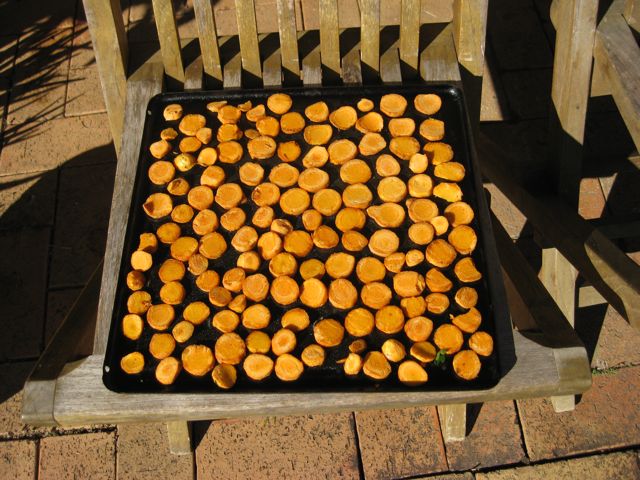
Drying turmeric in the sun

Ingredients
1.5kg chicken cut into 12 even pieces
NOTE:  For good flavour it is always to buy chicken with the bone in it and then cut it up.  The same goes for buying 'free range' (apart from it being 'against my religion' to buy an animal that has been reared in a cage)
2 tbsp ghee or vegetable oil
1/4 tsp fenugreek seeds
10 curry leaves (fresh or dried)
2 large onion, finely chopped (I do it in the food processor)
4-5 cloves of garlic, finely chopped
2 tsp fresh ginger, finely grated
1 tsp turmeric powder
1 tsp chilli powder (adjust to your taste)
1 tbsp ground coriander
2 tsp ground cumin
1/2 tsp ground fennel seed
2 tsp paprika
2 tsp salt
2 tbsp vinegar
1 can chopped tomatoes, or three fresh ones
6 cardamom pods, bruised
1 stick cinnamon
1 stalk lemon grass, bruised
1 cup coconut cream

Directions
1.  Heat ghee/oil and fry fenugreek seeds and curry leaves until they start to 'pop'.
2.  Add onion, garlic and ginger and fry gently until onion are quite soft and transparent.
3.  Add turmeric, chilli, coriander, cumin, fennel, paprika, salt and vinegar and stir well.
4.  Add tomatoes, whole spices and lemon grass.
5.  Add chicken and stir over medium heat until chicken is thoroughly coated with spices.  Cook, covered, on a low heat for 40-50 minutes.
6.  Add coconut cream, taste and add more salt and squeeze of lemon juice if desired.
7.  DO NOT COVER AFTER ADDING COCONUT MILK, OR BOIL, IT WILL CURDLE
8.  Serve with rice and your favourite sambal.

NOTE:  To make this 'a complete meal' I often add some vegetables about 15 minutes before it's finished cooking - this one had potato, carrot and peas.

Galangal in flower

Monday, August 6, 2012

Orange Marmalade: easy recipe for everyone!


Citrus is in abundance at this time of year and I have just been harvesting my first crop of limes and lemons - more exciting than watching the Olympics?!  It also means that I have been the grateful recipient of buckets and bags of oranges, mandarins, grapefruit, tangelos and pomelos.

As we had just finished our final jar of last year's batch it was time to pull out this tried and true easy recipe.

1 kilo of ripe oranges. (You can use a mix of citrus)
A WORD ABOUT ORANGES:  Just picked from the tree is best and I prefer the thin skinned navels.  I have made lots of marmalade from store bought oranges, but you really do have to avoid the overripe ones and those with a 'waxed' skin.  Success with marmalade really depends on the pectin content of the fruit which decreases as the fruit gets older.
1 lime (optional-I just like the combination)
2 lemons, juice and pips (gives a nice tangy flavour and the pips add pectin)
White granulated sugar - about 1kg (see note)
Filtered water - enough to cover the fruit once it is cut up
1.  Slice the fruit thinly.  I use the thin slicing blade on my food processor otherwise it is a pretty time consuming and messy business - this way all the juice is saved (otherwise you end up with juice running off the bench-top!)  Quarter the fruit first, leaving the skin on, and cut off the thick ends of the fruit and any white pithy bits out of the middle (this makes it bitter.)  Add any pips that may be in the fruit.
2.  Put in a non-reactive, heavy based saucepan.
3.  Add the juice and pips of two lemons (you will remove all the pips at the end of cooking) 
4.  Cover sliced fruit with filtered water and leave to stand overnight (or eight hours) with lid on. 
5.  After the sliced fruit has soaked overnight, bring to boil and simmer for one hour - making sure it does not 'catch' on the bottom by giving an occasional stir.
6.  Thoroughly wash the jars and lids you are going to use (this is where a dishwasher is a godsend!) and dry-off in a warm oven for about one hour - make sure it is not too hot or the jars will crack.  This sterilizes the jars so the marmalade will keep and not go mouldy.  At this point PUT A SAUCER IN THE FREEZER - trust me!!

7.  Sugar - to work out how much is required you will need to measure how many cupfuls of this fruit and water mixture you have because YOU WILL NEED EXACTLY THE SAME AMOUNT OF SUGAR.
This batch was eight cupfuls of sliced fruit and water so I needed eight cupfuls of sugar.
NOTE:  With this method you can make any quantity of marmalade.  If you are making this in the winter time you will need to warm the sugar in the oven before you add it to the fruit.  Putting cold sugar in stops the cooking process.

8.  Almost there!  After simmering the fruit for an hour ADD THE SUGAR AND BOIL RAPIDLY until it begins to 'get a bit crinkly around the edges'.  This is where the saucer from the freezer comes in.  Test to see if the marmalade has reached 'setting point' by putting a spoonful of the mix on the saucer.  If a skin forms on top of the marmalade it is ready (push it gently with your finger)  If not, keep simmering rapidly for a few more minutes.  Don't forget to stir it!  This last stage can take anything from a few minutes to about 20.  In the picture above, you can see that the marmalade is already 'crinkly' and sticking to the sides of the pan - this happened after just a few minutes of adding the sugar, because the fruit contained a so much pectin.  DO NOT CONTINUE TO COOK AFTER IT HAS REACHED SETTING POINT.

9. Skim off the pips pips with a slotted spoon.  It is now ready to put into the sterilized jars.  TAKE EXTRA CARE BECAUSE THE HOT SUGARY MIXES LIKE THIS CAN BURN BADLY.  I use a small metal jug to decant it. Cover the jars with a clean tea towel until it has cooled down then put lids on.  If you put the lids on while it is hot, condensation forms and can make it go mouldy.  

NOTE:  The process of writing this - in a way that is clear to others - has made me realize just how much I have learned along the way - firstly from my mother.  I hope you too find it useful and pass it on to someone else.  


http://www.blogger.com/blogger.g?blogID=3515306519466601297#editor/target=post;postID=323239880205794218

Wednesday, August 1, 2012

What is wrong with my papaya?


First of all - a big THANK YOU to the nearly 15,000 people who have logged on to to this blog since I started just a year ago.  I have absolutely loved sharing this information with you - finding the process of research and writing both stimulating and rewarding.  As I said to my husband the other day - I never know where this blog is going to take me - his reply, "Up the garden path"!!


My sick PAPAYAS
Note the mottled leaves, brown dead leaves and spotted fruit


When I came back from my trip overseas we had been away for over two months and the
garden looked mostly OK.  But, one plant looking very sick was my papaya. I had struggled for a while to keep it disease free but now had definitely lost the battle.

WHAT DID I OBSERVE?
 1. Black spots on the underside of the leaves, with them eventually turning brown and dropping off, and accompanying black spots on the fruit. 
2. Large necrotic spots on fruit and rotting of fruit.
ANTHRACNOSE affected fruit - note the pinkish sunken spots that eventually rot large areas of the fruit.

WHAT IS IT?  TWO different FUNGAL diseases that are common to this part of the world and anywhere that has high rainfall and subsequent high humidity.

1.  BLACK SPOT - Asperisporum caricae - a fungal disease which causes the black spots on the underside of the leaves, and while mostly cosmetic on the fruit this condition does affect the overall vigour of the tree (by reducing the ability of the plant to photosynthesize). Plants are more susceptible in cooler months.

2.  ANTHRACNOSE - Colletotrichium gloeaporides - this is a fungal disease that causes watery spots on the fruit and then rapid rotting and spoiling of all the fruit.  It starts as dark sunken spots or lesions and pinkish spore masses may form on the spots.  This can also affect harvested fruit if the fungus has take a hold.  This disease is spread in water droplets and is worse in warm, humid weather.  It can also be spread by infected seed.

My quest in trying to clearly to define these from 'expert' sources had definitely led me up the garden path - even my local fruit nursery misdiagnosed the problem.  So, I suppose the lesson here is that you have to observe closely and do your own research. 

The most important thing I learned was- PROBLEMS WITH PAPYAS ARE CLOSELY LINKED TO NUTRIENT DEFICIENCIES IN THE SOIL - fix the soil, fix your papayas.  Now, read on..................!
BLACK SPOT affected leaves and fruit on papaya

HOW TO PREVENT THESE FUNGAL DISEASES:

CHOOSE THE RIGHT PLANT:  Check before you plant that they are healthy and disease free.

WHERE TO PLANT:  Papayas like a well-mulched soil that is free draining.  Try to plant away from other shrubbery as a free air flow will help to reduce fungal spores from spreading.

SOIL PREPARATION:  Papayas are very susceptible to nutrient deficiency which weakens the plant and renders them more vulnerable to these fungal attacks.  

Black Spot is often a condition affecting plants deficient in POTASSIUM, PHOSPHORUS and MAGNESIUM.

Anthracnose affected plants are often lacking in CALCIUM and NITROGEN.

What this tells me is that the heavy rain we have had in recent times has depleted the soil of nutrients AND that papayas need regular feeding to keep them happy - a bit like us really!

1.  Check the pH (see UNDERSTANDING SOILS at top of page) - the wrong pH can 'lock-up' nutrients.  They don't like acid soils - which is what we get after long periods of rain.

2.  MULCH, MULCH and more MULCH - this will help to stop the nutrients from leaching away, add vital organic matter and essential nutrients.  Lucerne mulch is particularly good for increasing potassium/potash.

3.  GIVE THE SOIL A DOSE OF EPSOM SALTS - this is magnesium sulphate and will help with any magnesium deficiency.

4.  GET INTO GOOD HABITS - feed the soil!!! - remember food is only as good as the soil it is grown in - chicken manure, rock dust and a soil drench of trace elements after heavy rain.  Regular liquid feeding of the soil with COMPOST TEA (see previous post) or seaweed fertilizer will do the trick.

WHAT TO DO WITH MY PLANTS? 
1.  Rip them out and start again somewhere else in the garden - mine had been crowded out by other plants and I needed to put them somewhere with a better flow of air around them and more sunlight.  Destroy all affected plants.

2. You can cut pawpaw's back quite hard, almost to ground level, and they will re-shoot from the main stem.  When there is a flush of new growth DO A PREVENTATIVE SPRAY OF A COPPER BASED COMPOUND.


The same PAPAYA - now healthy - after cutting right back, feeding with an organic fertiliser (compost and rotted manures - which helps to correct pH imbalance and provide the macro-nutrients of nitrogen, phosphorous, potassium and calcium), mulching and applying some complete trace elements (supplying all the essential micro-nutrients like iron, manganese, boron etc) and monthly liquid feeds with compost tea during spring and summer.


Friday, July 20, 2012

Fresh Fennel Salad


FENNEL Foeniculum vulgare var.azoricum:

When I am away from home and can't sleep I do a mental tour of the garden - a bit like counting sheep - and it never fails to do the trick!  After a big trip overseas to the UK and Greece, it was great to get back and find how much everything had flourished but, for the first few days, because of all the unseasonal rain they had, I had to curb my itchy feet and fingers and stay indoors because the ground was like a quagmire.


One of the things I had to harvest straight away was this beautiful fennel.  I recently invested in a mandolin - not an instrument for duets with my ukulele, but a very sharp bladed tool for slicing things thinly - just what you need for fennel, but you have to watch your fingers as it is lethal (get one with a guard!).

It is easy to grow through the colder months - being used as a late winter vegetable either fresh or braised.  Just plant seedlings (seeds are easy to grow) in late summer in an old composted bed - it won't need any feeding after that - just keep well watered and harvest when the white bulb at the bottom is thick and fleshy.

NOTE:  'Bulb' fennel is also known as Florence fennel or sweet fennel and not to be confused with the straight species  Foeniculum vulgare -  an aromatic, rather weedy herb fennel which shows no swelling at the base; can get to over 2m and grows wild all over Europe. A familiar sight in Greece is to see folk (usually men) scouring the hillsides for 'wild' greens (horta) and herbs like fennel - they use it for cooking particular dishes - think cheese pies with fill pastry!

It's a prized vegetable in many parts of Europe - cropping up in lots of Italian, French and Greek cooking.  It's crunchy, sweet, aniseed flavour goes well in green salads or sliced with oranges - Italian style. Anything with these kind of flavours and fibre is very good for the stomach - I can guarantee that you will feel great after eating a meal with fresh fennel in it!


Fennel, Carrot and Beetroot Salad:  This is something I have eaten with fish in Greece.  It's simple to make with crunchy, fresh flavours and with beetroot, carrots and fennel being plentiful and cheap at this time of year, a good late winter salad.

1 fennel bulb, shaved thinly
1 cup grated carrot
1 cup grated fresh beetroot
1 spring onion, chopped finely
1 tsp toasted fennel seeds
Juice of 1 orange,
1/4 cup extra virgin olive oil
1tbs sherry (or red wine) vinegar
Salt and pepper


  • Toss fennel and carrot together,
  • Mix with toasted fennel seed and spring onion
  • Arrange grated beetroot around edge (or in the middle) - otherwise it will 'bleed' into other ingredients
  • Mix dressing and our over salad about 20mins before serving
  • Mix together orange juice, oil, vinegar and salt and pepper
  • Pour over salad just before serving
  • Garnish with fresh parsley, mint or dill
NOTE:  I also thinly slice fresh fennel over a salad of tomatoes and olives with a simple olive oil and lemon dressing.  Fish and fennel are also great partners.

NOTE:  Nicholas Culpepper is one of the most famous herbalists that ever lived and wrote the 'bible' for anyone interested in herbs Culpepper's Complete Herbal.  He just happened to live a very long time ago 1616-1654 and published his famous book in 1653.  Here's what he had to say about fish and fennel:

"One good old fashion is not yet left off, that is to boil fennel with fish: for it consumes the phlegmatic humour which fish most plentifully afford and annoy the body with.  I suppose the reason of its benefits this way is, because it is an herb of Mercury and under Virgo, and therefore bears antipathy to Pisces.  Fennel is good to break wind, to provoke urine, and ease the pains of the stone and helps to break it."  So there you go - from the horses mouth, so to speak


Sifnos, an outdoor oven perfect for cooking up some red mullet!


Tuesday, July 17, 2012

Great Dixter : Saving the best for last!


GREAT DIXTER, Northiam, Rye, East Sussex, UK
View from the 'Hovel' across the Topiary Lawn


I really knew nothing about Great Dixter before we paid a visit at the end of our UK trip.  I did have a small notation in my ‘little black book’ with a star beside it (which means ‘try and do if possible’) so I had seen something about it somewhere, but I wasn’t sure where or why?

Well!  What an absolute joy.  My husband Michael is not a gardener ( but he knows a good thing when he sees it!!)  and as soon as we walked in through the gate his jaw dropped open (mine was already on the ground) as he was exclaiming “oh my god” (along with a coach-load of French gardeners who had come for the day across the Channel - one of the joys and curses of being in Europe)

Entrance to the house
Great Dixter in Sussex is a 15th century house (Tudor style) and is unusual in that the gardens surround the house – one leading to the other – with views from the house to every part of the garden and back to the house again, which forms the central focus and gives feeling of intimacy.

The first glimpse of the house itself is truly a surprise being the oldest, largest example of a Tudor Hall in the country; it sits, like a timbered, reclining hulk in the middle of this glorious garden and is still occupied by members of the Lloyd family  Be sure to get a house and garden ticket - you won't be disappointed. (I would have given my favourite trowel for a few of the plant books in the magnificent library)

Self-seeded Iceland Poppies 
The modern history of the estate, and what we see today, starts with its purchase by Nathanial and Daisy Lloyd in 1909.  They then employed the eminent English architect Edwin Lutyens (famous for designing New Delhi) to help with extensions to the house and design of the garden.

Though Nathanial Lloyd began the gardens, it was his youngest son Christopher (Christo), born in 1921, who would make Great Dixter one of the most beautiful private gardens in the world. He lived there permanently from 1954 until he died in 2006.

The 'Peacock Garden'

Gardening is the English national passion as much as football.  In fact the whole landscape is cultivated (it’s hard to find a ‘wild’ place anywhere in England) and you are often looking at a rose bush or hedge that is a hundred plus years old – there are beautiful plants and gardens everywhere.  (The Chelsea Flower Show had just started when I arrived and the BBC devoted hours of prime-time broadcast every day for a week to this one spectacular garden show).  Gardeners here are stars of radio and television and, unlike footballers, write their own books. This was certainly true of Christopher Lloyd who was as much a writer as plantsman and gardener.  Finding out about all of this made me realise that I had ‘known’ him for a long time having, over the years, read some of his articles, but just not associated him with this fabulous garden that is Great Dixter.

This is not a fluffy cottage garden.  You are greeted with a view up to the house over breathtaking flowering meadow full of colour and movement with some ancient gnarled-trunked pear trees dotted here and there.

The meadows throughout the garden were a particular love of Christo’s mother, the aptly named Daisy – not an easy project to implement because wild meadows only grow on impoverished soils and usually means scooping tons off the top layer.  Well, a hundred years of perfecting the ‘dream’ have paid off - they are an absolute glory and only mown twice a year (so make sure you go when they haven't been mown) Sadly, 95% of meadow habitat in the UK has disappeared since the second world war which has resulted in a tragic decline of wildflowers and assorted wildlife – but the meadows at Great Dixter are going some way to demonstrate their beauty and conservation which go hand-in-hand with their year round education programme and workshops.


Your are then lead seductively around the garden along flagged pathways and clipped yew hedges to catch views into other ‘rooms’ via archways and gaps in the planting. Plants take centre stage at Dixter and Lloyd was renowned for his flamboyant use of strong colour, with blooms from the earliest spring bulbs right up until the first frosts of autumn – much of it self seeded from season to season.

The fantastic groupings of vibrant flowers, grasses, shrubs and trees was breathtaking.
Before Bunnings!

Every kind of skill a gardener has at their fingertips is in evidence at Great Dixter; dry stone walls, flagging, topiary, easpalier, hedges clipped to every size and shape imaginable, woven willow plant supports and screens, water features, sunken gardens, potted plants and so it went on.

The 'Long Border'
Apart from the meadow garden you also have the joy of discovering the high garden, the lavender garden, the sunken garden, the topiary lawn, the rose garden and the long border - which he made 300ft (100 yards) long. Enough to keep you busy for a lifetime.

If you can drag yourself away there is also an amazingly productive vegetable garden; the largest compost heap I have ever see; orchards and fantastic propagation area and retail nursery.

The 'Succulent Steps'

What this garden said to me was that here is NATURE in all its glory and here is the dedication, ingenuity and skill of MAN.  They have had a very happy marriage where they complemented and enhanced each other without domination – in other words HARMONY reigned.
The Meadow with Spotted Orchids


Fortunately the task of maintaining this balancing act is in the good hands of a private trust and the head gardener of 15 years, Fergus Garrett - who was an apprentice gardener to Christopher Lloyd.  The character of the place is still very much of those who lovingly created it and tended it for over a hundred years.  Unfortunately, this cannot be said for other houses and gardens that become ‘National Trusted’, like Sissinghurst.


Do put Great Dixter in your little black book - with lots of stars next to it - and make sure you go between spring and August (because they do their first cut of the meadow sometime in August and you will miss it!).


For an inspirational story about meadows and their importance go to this link Prince Charles and the Crown Meadows.

Thursday, July 12, 2012

Greek Salad:Back Home!!!!

iOS - the old hilltop town


It's exactly two months since I left home and I am sorry for the lack of input over the past few weeks.  After our visit to the UK we took ourselves off to travel round Greece for a month  (it was our 40th wedding anniversary - I really don't know where all those years have gone?) - Crete, Ios, Sifnos, Syros and Athens (all wonderful!) - and are finally home to a damp, chilly and wintery Mullumbimby evening.
GREEK - Greek Salad

The homecoming was not too bad: we arrived,with our luggage, and all in one piece; there were beautiful notes and pictures from our grandchildren to greet us plus a big bag of citrus from my friend's garden.  (I won't talk about the box of mail - mostly the kind you don't want in window-face envelopes).  A quick inspection of the garden (with a torch) made me happy - there has obviously been a lot of rain, it was flourishing and I was able to pick enough veggies to make a quick curry.


Ios - from the top!

To sum up the food in Greece - mostly wonderful - fresh, flavoursome, local varieties and produce, mostly sold bare weight - because the locals demand fresh food for at least one meal per day. The tomatoes and bread were worth the price of the ticket alone.  There was fresh food everywhere.  That doesn't mean to stay there are not a lot of unhealthy looking people - the standard Greek breakfast is 3 pieces of cake, 3 'frappe's'(iced coffee) and three fags (smoking is a national pastime!)


Fresh is best - local produce on Ios

The staple of every Greek meal is a salad consisting of tomatoes, cucumber, olives and feta cheese - dressed with dried oregano/thyme, olive oil and salt - Greek Salad. Optional extras are; thinly sliced red onion, capers, sliced green capsicum, braised fennel, chunks of toasted barley bread(Crete), soft cheese(Sifnos) - and there must be dozens more variations that I haven't tried yet.  If this sounds boring - it is not because the produce is fresh and has texture and flavour.  I asked my husband why he liked this salad too and he said 'because it's satisfying - when you eat a tomato in Greece, it's like eating a mango - and the cheese makes it hearty - a meal in itself'.

Our guide, on our way to Homer's tomb on Ios (and I thought he was not for real - Homer, that is?)

The trick to making a good Greek Salad - and believe me I have had plenty of bad ones outside Greece - is to make it with the best and freshest produce you can - that also goes for the olive oil and the olives.
Tomatoes - use ripe, but firm ones and cut into bite size chunks.
Cucumber - the small, thin Lebanese variety with either the skin peeled or scored so that it will hold the dressing.  No big, flabby ones please that are all seed.  Cut into chunky halved circles.
Olives - firm, whole ones - no pitted ones please (or you loose most of the flavour)
Feta - sheep or goats is best - creamy, but crumbly (not rubbery or too salty)
Olive oil - extra virgin and fresh - not something pale yellow that has been sitting on the bench top in a clear glass bottle for ages or, heaven forbid, a plastic bottle.
Put a slab of feta lastly on the top (not chopped up in the salad!) and drizzle the oil over the top of this and sprinkle with the dried herbs and sea salt.  Serve with fresh strong bread - essential for mopping up the salad juices.  See previous posts on slow-bread making and Greek baked beans (gigantes) for a complete meal.  Yamas!

Our 40th wedding anniversary on Ios - not a bad place to be!
Every talks about Ios being a mad party island, but if you go early or late in the season, you can have a wonderful time - we did!.

Friday, June 8, 2012

Postcard from Britain 5

Silent Spring - It's finally happened!
Flowering Hedgerows
The food security of everyone on the planet is totally reliant on a few things that often get totally taken for granted by those that control the production of food; healthy soil, water, sunshine and especially the unseen work of myriads of pollinators.

What has been noticeable to everyone in Britain, during an unseasonal week of warm weather, is that where this would once have set the place abuzzing the gardens, fields and hedgerows were remarkably quiet and the daily papers were full of alarmist letters noting the decline in butterfly, bee and other insect numbers - our pollinators.  Where gardens should have been humming they were now silent.  Rachel Carson's predictions from the 1960's in her book Silent Spring seem to have come true.

The consensus of opinion, from expert correspondents, was that the use of pesticides were to blame and particularly the neonicotinoids - a systemic synthesized pesticide based on the insecticidal properties of nicotine. ( See previous post Organic Gardening - Why Pesticides are Harmful).

"Moralists (archbishops included) can thunder away as much as they like; but they'll make no difference unless and until people see that there is something transforming and exhilarating about the prospect of a whole community rejoicing together - being glad of each other's happiness and safety. This alone is what will save us from the traps of ludicrous financial greed, of environmental recklessness, of collective fear of strangers and collective contempt for the unsuccessful and marginal - and many more things that we see far too much of, around us and within us."Archbishop of Canterbury - part of his Jubilee address. (See previous posts Economics of happiness 1 and 2)

NOTE: So rare now is the sight of a butterfly that I was stunned to see mechanised plastic butterflies spinning round and round in a garden I visited - is this a sign of the future?

"Natures' Companion Planting" - this was my husband's comment, while out on another ramble and negotiating our way through a large bank of stinging nettles with the antidote, dock, growing right next to it.  If you get stung, you simply break off a dock leaf and rub it on.

While the hedgerows may be quieter than usual they are certainly bursting with plant diversity and colour; white and pink campion, buttercups, daisies, forget-me-nots, Queen Anne's lace, poppies, hawthorn, elderberry, wild roses, hazel, etc.  Many hundred of miles of hedgerows were ripped out in the 1950's to make way for larger monocultured fields and the machinery needed to maintain them.  The vital role these ecosystems played was extremely undervalued, but fortunately this is now being recognised and many of them are being replanted (thanks, in no small part, to the lobbying of Prince Charles).

Wild rose with bee Rosa rugosa
"As we continue to destroy biodiversity, it's possible we are destroying the machinery that supports us"  Simon Barnes, Environmental Journalist, The Times, June 9th 2012

NOTE:  My Mother remembers, during the Second World War when fruit was scarce, people being employed to go out picking rose hips from the hedgerows to make a syrup rich in Vitamin C that was sent to the troops and given to young children.  And I certainly remember in the 1950's having excursions into the countryside to go 'black-berrying' in the hedgerows and picking baskets of elderberries for my Dad's homemade wine.

My parents live next to a chestnut wood on the Stour river in Suffolk.  Walking through the wildflowers there was amazing with violets, orchids and Miss Marpel's poisoners' favourite- hemlock.  I think that having this 'unsprayed' botanical cornucopia backing on to their garden may be the reason why they did have some bees flitting around and certainly lots of birds - including a song thrush and woodpeckers.
Stour Wood with coppiced chestnut trees and 'Jubilee weather'

Everywhere you walk in Britain you are treading on history.  This ancient wood was planted by the Romans about two thousand years ago.  A days march away (about 20 miles) is Colchester - one of their main settlements - and woods like these are scattered around Britain to provide shelter, fuel and food for the marching soldiers and settlers.  A great advantage of trees like these is that you can coppice them- that is - cut them down to the base and they will re-shoot long, straight branches (like many eucalypts).  Phil, my brother-in-law's friend is still employed as a woodsmen in a Kent chestnut wood, cutting the timber for poles and fencing. ( It was once used for the Kentish hop-poles).

NOTE: These are the Spanish Chestnut Castanea sativa native to North America and Europe.

NOTE: I often get the feeling, when I am walking through these woods, that a troop of Monty Pythonesque Roman soldiers are going to come clunking along the muddy path with Eric Idle muttering "not bloody chestnuts for dinner again!" and the rest of them singing "Always look on the bright side of life"

Saturday, June 2, 2012

Postcard from Britain 4 - The Swinging Sixties

Where Did the Swinging Sixties Start?
Me and 'The Dirty Duchess'


Two degrees of separation!!  I saw in the Times this week 48 Upper Grosvenor Street, Mayfair was up for sale and in surged a flood of memories.  This was the home of the Duke and Duchess of Argyle and she was was at the centre of a scandalous divorce in 1963 and is said to be the catalyst for the start of the 'Permissive Society' and the 'Swinging Sixties'.

When the Duke of Argyle filed for divorce he stated that his 52 year old wife had had 88 lovers and provided as evidence a polaroid snap of the back of his naked wife in a sexually compromising position with an unknown naked male (not the Duke).  He appears as a headless torso and was said to be either Douglas Fairbanks Junior, Duncan Sandys (Secretary of State for the Colonies), or a member of the Royal Family.  The Duke said it was clearly his wife in the photo, positively identified by the family pearls she was wearing - in fact the only thing she was wearing!!

So lurid were the goings on at number 48 that Phillip Larkin later declared that 1963 was the year that `'sexual intercourse' began.

How, you may ask did I become involved in this hotbed of history making?

In 1972 I worked next door to the Duchess at number 44.  Her chef, Giovanni,  just happened to be the landlord of the building I was living in Penge. south east London, as a newly married 22 year old.  At lunchtime I would slip out into the cobbled mews at the back of number 44 and down into the basement of number 48 for a delectable lunch - courtesy of the Duchess and cooked by Giovanni.  He was Italian and like to spoil me because I was pregnant.

My life was never as racey as the Dirty Duchesse's, but I like to think that via her basement  I got a peephole into the movers and shakers of the Swinging Sixties.

NOTE:  I did scream at a Beatles concert at the Lewisham Odeon in 1964, along with Chuck Berry, Ike and Tina Turner, the Yardbirds and Small Faces.  But my favourite were the Kinks ("Girl, you really got me going") and the highlight of my week in 1966 was to go to the Marquee Club on a Friday night and see this hot group with a really steamy lead singer called Mick Jagger.  Oh, and I did marry a base guitarist.


NOTE:  Upper Grosvenor Street formed one side of the once beautiful Grosvenor Square flanked on three sides by lovely Georgian terraced houses - home to the rich and famous of this, the heart of Mayfair.  I always found it incongruous that the western side of it was dominated by an extremely ugly Stalinist concrete building that looked like the headquarters of the KGB - in fact the American embassy.  I was reminded of the impovrishing devastation to the architectural heritage imposed on the heart of London during the 1950's when I saw the ugly buildings along the Thames, that now dominate, during the Jubilee regatta.  The Times had comparative images of Canaletto's painting of a similar scene from the 18th century where the Thames was then flanked by buldings full of grace and beauty (and you could see St. Paul's and not just the dome poking above a large grey concrete lump!)


Monday, May 28, 2012

Postcard from Britain 3

Tesco's, Woolworth's - Same, Same
I am staying in the village of East Malling, Kent, though there is not much of the village life left - just a pub, the King and Queen which dates from Tudor times, and a church.  It's mostly now a traffic snarl for cars doing a rat run to get on the M25 in and out of London.

West Malling is three miles away and has been a large market town for nearly a thousand years.  It was founded in 1090 by the chap in the village sign above, Bishop Gundulph who started a centre for Benedictine nuns under control of an Abbess.  Under charter from the Abbess it became a centre of rich agriculture which brought markets, fairs, shops and people. It was only the shenanigans of HenryVIII that brought about the dissolution of the monasteries and the demise of the Abbey after 500 years.  Early in the 20th century it was revived and still operates today.

The history of West Malling is depicted on the back of this wonderful statue in the middle of the High Street.  It's called 'Hope' by Sarah Cunnington.

During the Black Death in 1348 only 15 people in West Malling survived and the first game of cricket was played here in 1704.  The uprising against Mary Tudor was put down here by troops from West Malling.

Hope is about the only thing left for the survival of this beautiful old village because what the Black Death, Reformation and a thousand years of history has not managed to do TESCO'S HAS.  This once thriving centre for fresh food has been extinguished by this one supermarket that operates in the centre of town.  West Malling does not now have one remaining food shop within miles.  Everybody shops at Tesco's.  The market square, in the centre of town, is now just used for the Tesco trucks.

On a brighter note.  West Malling had an 'open garden' day yesterday and I had a happy afternoon cycling around the eight gardens on show.  I started off in a Georgian Villa with the brass name plate of 'Lucknow' on the front door -  I can just imagine some old colonel returning from India to a place like this.  It had packed full courtyard garden with this beautiful rhododendron.

Bourne House, next to the old Church of St Mary's, dating from 1670 was my pick for the day with  it's design formula from that pioneered by Vita Sackville West and Gertrude Jekyll in the 1920's - formal design with informal planting - termed English Revival and still popular in garden design - it's how my garden usually end up. They also turned on a top afternoon tea!


Bourne House had a lovely 'hot border' with red, yellow and orange plants including this spectacular Iceland poppy hybrid.

In the corner bed above they have more hot colours with the more muted pastel colours of lupins behind it - pots give a focal point in the garden - here indicating the corner of the pathway.


Alliums have also become very popular as perennial bedding plants.  They are a large group of plants in the onion family with wonderful globular flower heads - we can grow these!  They come in various heights with white, blue and all shades of mauve flowers.

Sunday, May 27, 2012

Postcard from Britain 2 - Chelsea Flower Show 2012

"Oh to be in England now that spring is here"
Jilly and Carl's newly created woodland garden framed by a copper beech
My husband Michael's sister(Jilly) and mother live in a beautiful part of Britain - the Kentish Weald - otherwise known as the Garden of England for it's centuries old cultivation of orchards: apples, pears, plums and cherries, and berry farms - especially strawberries and raspberries.

Jilly and Carl have a lovely garden (about 2,000sq.m.) and are keen gardeners. It's wonderful to see, every time I return, the rewards of their labours.  Since Carl retired he has done a RHS horticultural course so we always have lots 'compos't and 'worm' type chats.

Kentish apple orchards with oast houses
Kent was once also famous for its hop gardens too (used in the making of beer), now long gone - the only memory in the landscape are the conical shaped oast houses that were used for drying the hops.  Many families in my grandparents era from the East End of London used to come to come to Kent for their summer holidays to go hop picking.
Flowering horse chestnut (for you Alison)
We have arrived in late spring and the beautiful old deciduous trees are in full, fresh green leaf - oak, birch, linden/lime, hazelnut, chestnut and my favourite - the copper beach.  They are also in flower and the air is full of the fragrance of hawthorn, chestnut and linden trees.

The house we are staying in is over a hundred years old and the backdrop that frames the garden are two magnificent copper beech trees (seen in the first photo above).Which brings me to the CHELSEA FLOWER SHOW celebrating it's centenary in 2013.  It's been a treat for me to watch the all-day live broadcasts from the Show, to hear the word horticulture dozens of times, and see the craftsmanship that goes into the bones of a garden: stonemasonry paving, hedging, pollarding, topiary, fencing, espaliering, plant selection and, this years star - pleaching.

Themes this year from the Chelsea Flower Show:

Laurent-Perrier Gold medal garden with pleached copper beech
Design: A formal Italianate garden was the Gold medal winner.  It had lovely water features, topiary and a pleached copper beach hedge - how to explain this - it's a sort of living fence, the trunks of which are bare underneath and then it is clipped to height and width.  I first saw this as a feature at Sissinghurst (Vita Sackville West's garden) with a pleached lime walk with spring bulbs underneath.

I don't think this is a trend that will take on in Mullumbimby - we don't have the staff to maintain them!  But, I do love the skill of separating spaces in the garden and creating privacy with plants and not built structures; we don't think of the vertical enough when designing a garden.
.
Recycled water was also incorporated into lots of designs as well as 'wild and sustainable plantings'.  There was another award winning very small back yard with an old caravan as the central feature and plantings reminiscent of an Enid Blyton 'Famous Five' holiday - hollyhocks, columbines, tumbling roses and forget-me-nots and lashings of ginger beer.  In fact, I sometimes think here, back in England,  that I am going to see Rupert Bear and Bill Badger appearing from behind a hedge at any moment.  Jet-lag allows you to welcome the dawn at 4.30am and as I look out in the garden I see rabbits, squirrels and hedgehogs scurrying about.  On my cycle ride back from West Malling yesterday - in a shady country lane - I came across a fox with a cub that stayed quite still until I got really close to them.

Colour:  Lots of metallic colours in leaves and flowers, silver, copper and bronze.  Note the use of silver artichoke as a feature plant in the garden above.

NOTE:  If you want to see the garden an Australian team won the gold medal with in 2013 go to this link.